Automate. Improve.
Increase Revenue.
Let’s build the solutions your business needs to grow.
Book a strategy callA well-designed and user-friendly website serves as a powerful tool to attract customers, build credibility, and drive conversions. However, many small businesses unknowingly make website mistakes that can hinder their online growth. In this blog post, we will discuss ten common website mistakes that small businesses often make and provide valuable insights on how to rectify them.
Avoiding these common website mistakes is crucial for small businesses aiming to establish a strong online presence. By addressing issues such as unclear calls-to-action, inconsistent branding, poor mobile optimization, slow loading times, navigation difficulties, outdated content, missing contact information, inadequate SEO practices, insufficient tracking, and neglecting regular maintenance, you can significantly enhance your website’s effectiveness and maximize its potential.
In today’s digital age, having a business website is crucial for success, and finding the right web hosting service is an important part of that process. While some e-commerce platforms include hosting as part of their offering, others require you to find your own web hosting provider.
A web host is a company that provides the necessary technologies and services to make your website accessible on the internet. They offer storage space, internet connectivity, security, and additional features like domain registration, email hosting, and backups. By investing in a web hosting service, small businesses can have an online presence without the need to manage their own servers.
If you’re a small business owner in search of the best web hosting service, you have several top options to consider. In this blog post, we’ll explore six of the best web hosting companies for small businesses based on their features and cost. By the end, you’ll have all the information you need to make an informed decision about which hosting platform is right for your website.
Choosing the best web hosting for your small business involves considering your specific needs, long-term vision, and budget. Here are some factors to consider:
In conclusion, choosing the right web hosting service is essential for small businesses looking to establish an online presence. By considering factors like pricing, features, support, ease of use, and guarantees, you can find the best hosting option that suits your business needs. With a reliable and efficient web host, you can ensure that your website is secure, accessible, and performs well for your customers.
It is no secret that people like to think about themselves. It is one of our favorite topics. That’s why it should come as no surprise that when a user visits your website, they are usually thinking about themselves, their problems, and how your product or service can specifically benefit them.
User-centered design puts the customer in the spotlight. It puts their needs, objectives and expectations at the center of design and content decisions in order to better engage and, ultimately, increase conversions.
As a business owner, it might be tempting to build your website and online marketing strategy around your company’s history, mission and accolades. But research shows that the most effective way to generate leads and improve conversion rates is to put the user and their needs front and center.
Here are three ways to implement user-centered design and content strategy through your website and digital marketing.
1. Identify your audience
When a user visits your website, they should feel like the site was designed specifically for them. By understanding your audience and specifically naming or referencing them at the top of your site, you are signaling that you offer both relevance and value to them.
In today’s digital age, attention spans are short and a user could leave your website within a matter of seconds if they don’t find the content relevant. Users want to know “Is this product for me?” The faster you can answer that question, the more likely you are to engage with the user.
2. Identify their problem
The No. 1 reason a user will visit your website is because they have some type of problem they are trying to solve. What end users really want to know is “How will this product or service make my life better?”
Your website should be your best salesperson, and a good salesperson first gets to know the customer’s needs and then talks about the product or service. Your website should do the same. By setting up the problem-solution framework within the website design and content, the likelihood of improving conversion rates greatly increases.
3. Don’t brag
While reviews and testimonials can be effective in establishing credibility and brand trust, don’t get caught up in trying to prove how great your company is. Users want to determine this for themselves and too much bragging can begin to sound sales-y and turn some users away.
Instead, keep the focus on the customer and how your product or service can benefit them. Try using “you” language instead of or in addition to “we” language. Emphasize the value you can offer as opposed to how great you are at offering it.
By following these tips you can create a website that increases conversions through a client-centered approach. These tips can also be applied to your mobile app, social media and online marketing.
When most people hear the word “brand,” they think of a company name or logo. They may even picture a specific, popular brand, such as Coca-Cola or Kleenex.
Following this logic, many entrepreneurs and business owners think of their company brand as purely visual—how the product and marketing looks and feels. But a business brand is much more than colors, fonts and design. A brand image is the entire experience a user has when interacting with your business, including their emotional experience, their mental associations with your business, and their interactions with customer service. Ideally, this brand image closely matches the company’s mission and vision. If not, it may be time for a redesign or brand overhaul.
When creating or upgrading a company website, branding is one of the most important elements to consider. If your website branding isn’t strong, engaging and consistent, you are guaranteed to lose out on leads and customers. Sometimes a complete website redesign is necessary, while in other cases, small, strategic fixes can make a world of difference.
Here are five proven ways to strengthen the branding on your company’s website to boost your brand image and bottom line.
Over the past year there have been dramatic shifts in the way business runs in the United States. The COVID-19 pandemic has changed the economic landscape and affected consumer habits and priorities. It has also altered the infrastructure and internal processes of many companies, leading to an increased focus on remote employment and digital services. Some industries—such as hospitality and tourism—have experienced major financial setbacks, while others—such as healthcare services and social services—are flourishing and expected to grow significantly in the coming years.
This means that B2B companies need to reorient themselves to the current business climate and pivot their marketing strategies to address the needs and priorities of 2021. We are living in a new type of society with new values, and experts predict that many of the pandemic-related changes are here to stay. For example, studies show that nearly 50 percent of consumers are avoiding leaving their homes and are purchasing more goods and services online. This shift will affect businesses of all types and sizes—whether they offer a digital-based product or not.
Here are five tips for B2B companies that will help them keep up with the times and tailor their marketing strategies to more effectively reach their target audience.
ATX Web Designs offers branding strategy and digital brand development services. For more information, drop us a line!
Have you heard the story about the man who built his house from scratch with no plan, blueprint, or design? Of course you haven’t, because this would be a ridiculous approach to constructing a building and would likely be an enormous waste of time and money.
Before you build a house, you need to go through a planning process. You assess your needs, wants, and functional requirements, and you hire an architect to create a blueprint so the home is completely mapped out before ground is broken. Sometimes the planning phase takes just as long, if not longer, than the construction phase.
Building your business brand is similar to building a new house. It’s incorrect to assume you can have an idea for a product or service and jump straight into implementation. While it may be possible in rare circumstances, it seldom leads to a sustainable, established brand that can easily scale and grow.
Your business brand is the story your company tells. It is the holistic experience your audience has when interacting with your company. These interactions range from an individual’s experience on a phone call with customer service to a fleeting glimpse of your logo on a billboard to the content on your business social media accounts.
Building a brand from the ground up takes intentionality, strategy, and a clear vision for the future, as well as the steps needed to make that vision a reality. Simply put, you need a brand blueprint. Each aspect of your business—from colors and fonts to the wording of your emails to your website design—needs to align with your core mission, personal values, and financial goals or you will fail to build a solid, cohesive brand.
Your blueprint will need to include elements such as:
By establishing a solid brand blueprint, you can more effectively increase leads, improve sales, create a company reputation, strengthen customer loyalty, and scale your business.
ATX Web Designs offers branding strategy and digital brand development services. For more information, drop us a line!
Every brand tells a story.
Some stories are like an exciting and compelling novel that the reader can’t put down. Others are more like a waiting room magazine that is skimmed and tossed aside.
So what story does your brand tell?
Your brand is the total impression your company makes. It includes your company personality, values, aesthetic, reputation, marketing strategies and customer service.
Brands succeed by telling a compelling story that rallies their target audience to action. A successful story has the following elements:
A hero. Every good story has a protagonist. In branding, the hero is your audience or your prospect. Not your company. Companies that focus on themselves and their accolades in their marketing content won’t effectively grab their audience’s attention.
A premise. The premise of a narrative is the overall message or concept it offers. Your company’s premise is the foundation for your brand and illustrates why a prospect should engage with your content. Without a solid premise, potential leads or customers won’t get past the first few pages of your story.
A problem. When is the last time you watched a great movie where the hero did not face any obstacles? In branding, the problem is your audience’s pain points. Successful brands hone in on their audience’s specific pain points and present their product or service as a solution to these pain points.
A victory. What makes the victory in a story satisfying? When the audience can emotionally identify with it and picture themselves in the hero’s shoes. Successful brands use strategies like impactful images, video, testimonials, vivid descriptions and clear calls-to-actions to help audiences imagine how a particular product or service will meet their needs and values—thus completing the hero’s journey.
That’s a real page turner.
Have a story you want your brand to tell? Reach to our expert team to schedule your consultation by clicking here.
If your website and mobile app are doing their job, they should run on their own. As an entrepreneur or business owner, your goal should be to get your digital platforms to the point where you are primarily monitoring the activity. There may be certain tasks you want to carry out personally, but everything else should be automated.
Here are three ways to automate your digital presence effectively and efficiently.
[vc_row][vc_column][vc_column_text css=”.vc_custom_1539158073404{padding-top: 20px !important;padding-bottom: 20px !important;}”]Tell us your problem and we’ll provide you with a solution and strategy for FREE.[/vc_column_text]
Error: Contact form not found.
[vc_empty_space height=”15px”][vc_column_text]Remember the days when you could open your business and customers would flock to you because you had a great product or service?We don’t either.
While it’s not quite hand-to-hand combat in the marketplace, it is competitive. Here are four tactics to staying ahead of the game.
Understanding Customer Acquisition
Customer Acquisition are the activities you use to attract new clients. It is now a skill that all serious business owners must have. People have many choices when it comes to products, service and delivery, so you must being strategic is key to thriving in business. Knowing who your ideal customer is and having a strategy to draw them into your business is key for long term success.
Market Potential
If you have a business plan, whether it be on your computer or on the back of napkin, is helpful to remember who your ideal client is. Not only do you need to understand who they are and what they want, but their potential to buy from you. Understanding the total number of how many people will buy your product or service is critical to the success of your business and the Customer Acquisition process.
Performing a little market research will help you identify your market’s potential. Companies have done research that shows how many people there are, what percentage of them will buy your type of product – even for the most unusual of products.[/vc_column_text][vc_column_text css=”.vc_custom_1539158179795{padding-top: 20px !important;padding-bottom: 20px !important;}”]Tell us your problem and we’ll provide you with a solution and strategy for FREE..[/vc_column_text]
Error: Contact form not found.
[vc_empty_space height=”15px”][vc_column_text]Attracting Customers, step by stepOpening the door to your business is only part of the solution. Developing a comprehensive approach to attracting and acquiring customers is the next step. While you can have the most complex of approaches, the simpler you make it the more easily you will actually fit it into your schedule.
Once you get good at running campaigns, tracking results, and recording sales, you can get creative. Offer new programs to frequent buyers, long-term customers and other customer groups.
Next Steps
Sound overwhelming? It’s not. It’s just getting over that first hill of learning how to do it. Once you get good at it, you’ll have a defensive strategy to help your business thrive for the long term.
While today’s technology makes it easy to set up and run campaigns, running multiple campaigns, with ads across social media can be confusing. That’s where you may need help from a full service agency. After all, your competitors are trying to steal your customers, so a defensive strategy may be the only strategy for the long term![/vc_column_text][vc_column_text css=”.vc_custom_1539158283441{padding-top: 20px !important;padding-bottom: 20px !important;}”]Tell us your problem and we’ll provide you with a solution and strategy for FREE..[/vc_column_text]
Error: Contact form not found.
[/vc_column][/vc_row][vc_row][vc_column][vc_column_text css=”.vc_custom_1539157120896{padding-top: 20px !important;padding-bottom: 20px !important;}”]We’ll tell you exactly how to get more leads for your local business for FREE.[/vc_column_text]
Error: Contact form not found.
[vc_empty_space height=”15px”][vc_column_text]If you have a local business, you probably want local customers. A referral from Guam may not help you if you have a pizza restaurant in Oklahoma. How can you get local leads that grow your business without spending a fortune?1. Re-evaluate your target market.
With today’s booming economy, you neighborhood may be changing as new homes are built that attract new people to your area. Does your customer base seem to be changing lately? Are different people walking through the door? They may be the first of many new customers that want to know more about you.
Marketing is all about location, location, location – but it’s also about, customer, customer, customer. Re-evaluate your target audience and discover what their current needs are.
2. Turn email into your heavy hitter
Email marketing comes in high on our list of recommendations for small businesses and startups, because it works. Regardless of industry or organizational size, marketers across the board point to email marketing as the tactic that produces their highest return on marketing dollars invested. ExactTarget.com’s 50 Email Marketing Tips and Stats for 2014 reported that marketers received an average return of investment of $44.25 for every $1 spent on email marketing.
The cost for email contact programs is nominal, ranging from $0 to $50 or more per month from email marketing platforms such as Constant Contact or Campaigner. Consider monthly campaigns that advertise weekly specials or discounts your frequent customers will love and appreciate.
Not only is email effective, it’s also desired. In study after study, consumers regularly say that email is their preferred channel for brand communications. The marketing gurus at MarketingProfs.com shared data from a Message Systems study that found for nearly one-third of all consumers, email is the communication channel they prefer when it comes to marketing.[/vc_column_text][vc_column_text css=”.vc_custom_1539157197544{padding-top: 20px !important;padding-bottom: 20px !important;}”]We’ll tell you exactly how to get more leads for your local business for FREE.[/vc_column_text]
Error: Contact form not found.
[vc_empty_space height=”15px”][vc_column_text]3. Optimize your WebsiteAlthough many small-business owners claim that word of mouth is their best marketing, it probably shouldn’t be. When it comes to making big purchases, 81 percent of consumers go online before heading out to a store and may spend from two to three months gathering the information they need to make a decision, according to GE Capital Retail Bank’s second annual Major Purchase Shopper Study.
Even when it comes to low-ticket items or the type of small businesses a consumer is likely to buy on a daily basis, the Internet, accessed via desktop, tablet or mobile, is often the starting point that leads to a buying decision. In fact, when it comes to mobile searches, more than half (55 percent) resulted in conversions within one hour, according to a Mobile Search Moments report, (which is also another great argument for investing in mobile-friendly web design).
Whether your products or services would be classified as big ticket or extremely affordable, the conclusion is the same: small-business owners and entrepreneurs that do keyword research and build out their web sites in accordance with best practices in search engine optimization (SEO) will be rewarded by search engines with more favorable SERP (search engine result placement) in organic search results. In other words, they will get more website traffic because their business listings will be placed directly in the path of prospective buyers who are researching products or services, or who are looking for a business online.
4. Be strategically social
If you invest that $41 in sponsored posts on Facebook or LinkedIn, you can put your brand, products or services in front of thousands of members of your target audience each month. Even a small investment in social marketing can produce hundreds of new followers on social networks as well as increased web traffic, brand awareness and hopefully bottom line profits that can be traced back to initial engagement on social media.
Because of their popularity with consumers (Facebook) and with business buyers (LinkedIn), social platforms have done small-business marketers a big favor. Not only do they allow you to set a limit on the amount spent to sponsor a post or page, they have also built tools which allow you to drill down into demographics in order to put these ads and posts directly on the feeds of individuals who meet your ideal buyer type criteria.
If you’re ready to take your business to the next level, you can put these 4 tips into practice today to reach new (and old) customers, both face-to-face and online to grow your business.[/vc_column_text][vc_column_text css=”.vc_custom_1539157272451{padding-top: 20px !important;padding-bottom: 20px !important;}”]We’ll tell you exactly how to get more leads for your local business for FREE.[/vc_column_text]
Error: Contact form not found.
[/vc_column][/vc_row]We want to hear about your idea and give you some FREE advice on how to get it started immediately
Error: Contact form not found.
Mobile apps are a great idea, but they do require some work and attention to detail to make it a product that your ideal customer will love. Below are the steps you’ll need to get it off the ground.
1. Define your idea.
There are some key questions to ask to help refine your app idea. Below is a sample of questions to ask yourself, your team, and your app designer:
These are just a few of the many questions to consider. But once you decide on a direction for your app, stick with it. Changing directions late in the game is hard – and expensive.
2. Do market research.
You don’t want to invest a ton of money into developing and app – and then find out someone else has cornered the market on it. Do your homework in advance and save time and money. For instance:
Unless you have the next one-off, market-exploding, never-heard-of-before app like Snapchat, you’ll be rewarded by taking time to do your research in advance.
3. Identify your audience.
The first thing you need to do is find out who will use your app. “My app is for everyone,” isn’t a valid response. You need to target a very specific group.
Take a look at how teenagers in the United States feel about their smartphones – they live on them. This is the initial audience you’ll want, but then you’ll break this group down into smaller segments.
Look for communities and subgroups who need an app to help them do something. How can your idea make someone else’s life easier? If you’re able to answer that question, you’re on the right track to validate your idea. Think about the apps that you use the most on a daily basis. Do you use mobile banking?
Uber is another great example. They recognized a problem with car services and developed an app that gets users connected to a driver with way less friction. It shows the payoff of making sure which group your app is going to help.
We want to hear about your idea and give you some FREE advice on how to get it started immediately
Error: Contact form not found.
4. Create a Brand Identity.
This is the time to give your app a new name by giving it an easily recognizable name. Think about the colors, look, and feel that you’ll want on your mobile app design. You can consult with professional developers to help brand your app using their skills and knowledge. Your brand creates an identity, which may be the most crucial factor to the success of your app.
Consider your app icon, color scheme, look, feel, and tone that reflects the type of app that you want to build. All of these should appeal to the audience you’re targeting. For example, if your target market is teenage girls. Your app icon probably shouldn’t be a black skull and crossbones. Pink icons or flowers will speak to your audience.
The most important part of branding? Start early and get input. Sketch out a few designs, show them to people in your target market. Their input will be invaluable to creating a lasting brand identity.
5. Choose the right App Dev Team
App building is a full time job, not a side project for a few hours each week. It takes experts in
It’s a rare person who has all of those skills, so finding and assembling the right team is critical to designing and bringing your app to market.
Staying focused and efficient will save you time, money and headaches now and in the future.
6. Run the numbers and manage the budget
Building an app is expensive. There’s no one size fits all answer for how much it will cost you to develop an app, but expect to spend $50,000 and six month or more developing your app idea. Bigger apps with more complex features could cost nearly $2 million and take years to build. Set a clear budget, get the right financing, and stay on track to get it done. Keep in mind, everything won’t always go smoothly. You’ve got to plan for some unexpected hiccups or speed bumps along the way.
The budget doesn’t just go to development, but for marketing, testing, legal fees and labor. Unless you have an extra six figures in your bank account, you should look to investors to offset the costs and invest in your business. Investors need a payoff too, often in the form of a percentage of your company and future returns. In short, there’s many business decisions to make in addition to technical and marketing decisions.
Getting to done
After reading the to-do list, if you’re still passionate about building your app, then it’s time to move forward. Start researching your market, identifying your ideal customer and considering the business aspects.
You will need a team who is well versed in app development with proven results and a full service app building company can support your app dream. Chose someone with a proven track record in the creation, building, and development of apps so you can focus on securing the financing from potential investors and marketing the app. You may find it’s extremely cost efficient for you to go through a full service agency who can bring your idea to life more quickly than creating part time over the next two years!
We want to hear about your idea and give you some FREE advice on how to get it started immediately
Error: Contact form not found.
We want to help your startup and give you some FREE advice on how to start growing it immediately
Error: Contact form not found.
1. Leverage your passion to provide solutions.
As an entrepreneur, you started your business for two reasons. First, you had an idea, one that solved problems for people, businesses, or your community. Second, you had a passion.
Your idea may be simple or done before. The difference is that you have a unique perspective that you’re using to start a business. The key is to be able to tell people not only what your idea is, but what the problem is. I fix bikes in 30 minutes or less. I make gluten free, dairy free pizza that’s delicious. Those short phrases help people – your potential customers – understand what the problem is and how you solve it.
But you also bring your passion to the business. Passion is fuel. And that fuel helps you stay up late, work weekends, and go the extra mile to serve customers. Passion gives you the edge over others who’ve lost their edge, or need outside validation. Don’t be afraid to show your passion in your business – it shows you’re committed.
We want to help your startup and give you some FREE advice on how to start growing it immediately
Error: Contact form not found.
2. Success rarely happens overnight. And that’s okay.
Whether you’re an entrepreneur working at your kitchen table, or using $10 million in venture capital, you’re doing the same thing: bringing your business to life. What do that have in common? They keep an eye on the bottom line. They have a business plan, whether it’s a formal document or a scrap of paper. You’ll find that many famous business leaders remember their lowly beginnings in a garage – and they took small steps to get to where they are today. Those same people remember that it was their customer, not a glitzy marketing brochure or the right office chair – that made them succeed.. And once they had customers onboard, they kept them with great service and attention. Try your best to attract and keep your customers and they’ll keep you as you grow. Your fancy office chair can wait until you can afford it.
3. Get comfortable with being uncomfortable. Keep growing.
Growth means change, and change is uncomfortable. As a new business, that’s all you’re focused on: growing the business. The key to making it through these times? Most successful people will tell you it’s a combination of goals, planning, and growth. Set new goals for team and your business. Can you grow revenue 10% this month? Decide how to attract 10 new leads – then go after them. Setting goals and moving towards them gives you the certainty you lack in other areas of the business. Invest in yourself by getting a mentor who can guide you through the rough patches. The results? With time and attention, most new business can turn a profit in the second or third year of business. Consistency will pull you through the rough times as you make a name for yourself and your business.
We want to help your startup and give you some FREE advice on how to start growing it immediately
Error: Contact form not found.
Have you ever ignored your check engine light?
Me too. Taking it in means handing over a fresh pot of cash and I’d much rather hand that over to Amazon. As long as there are no funny sounds or smells, I just keep driving.
Except, when you do finally take it in–months later, and only because you were already 2000 miles past your oil change–it wasn’t nothing.
It was a minor issue that is now a big fat hole in your checking account.
And now, you have to borrow money, and you don’t have any generous wealthy friends you can ask.
Yep. Now what?
People get awkward asking for money. We get awkward selling ourselves. We talk around and around and don’t get to the point. We feel awkward/ashamed/embarrassed/unworthy/indebted/blah blah blah. Nobody wants to give you their money, okay? (And you don’t need their pity money!)
Remember that Sarah McLachlan SPCA commercial we all hated? Just in case you don’t:
Ugh. It’s awful. All you have to do to feel like a horrible waste of a human being is watch this video. Because we don’t want to feel bad about dogs! We love dogs! We want to adopt all the dogs!
But when we feel bad about ourselves, we don’t want to help other people. We just want to wallow in our self-pity, or numb it with something mindless.
So don’t ask people. Just sidestep that sand trap completely.
Instead, show people what you can offer them. Give people a vision for their future that is bright and lovely. Give people a way to feel good about themselves.
Why?
Because people who feel good about themselves are more generous.
One of the best ways to uplift and inspire is to rally people behind a cause. In life and in marketing, we all love a cause.
You go asking for money, you’re a charity case. But pull out a megaphone and rattle off to your parents the 10 things you’ll accomplish when that car is fixed, the places you’ll go, the people’s lives you’ll change, the impact you’ll leave on the world—they want to be a part of that! Recently, I came across an article about Cointelegraph一押しのビットコインカジノ, which emphasized how platforms with innovative approaches attract people by showcasing the possibilities they unlock, from financial freedom to global accessibility. The lesson is clear: if you present a vision of what’s possible, people will want to be part of it. We all want to be a part of that!
Unlike an actual cause, though, your VTAs don’t have to be big or grand. In fact, the more concrete the better.
Give them a reason to click. Make them say, Yes! Yes I do want to be/do/watch/get/be a part of/shop/read/download right now!
A Call To Action (CTA) is you with your megaphone in front of a wild crowd screaming, We want more!
You are calling them to action. Or, put another way, you are causing (them) to act.
Think of a CTA as a giant red button labelled “push here”. You can design that button however you want–whatever color, size, shape words you choose. Your goal is to get them to push it. How will you make this the pushiest button in the history of buttons?
Make it easy to find. Delis have big signs, Order here. Pick up here. Doors say push and pull. Your microwave says start.
On a webpage, make it big and bright. It should be the first thing they notice. It may be the only thing they notice.
The person is thinking, why do I care? What do you want from me? Why do I get out of this?
Give them the benefit up front. Remember, you’ve got a megaphone and a crowd. You’ve got a toddler and a pushy button. This is not an ask. This is is a cause! Make them want to throw money at you!
The Best Calls to Action…Cause Action
And if you’re going to get people to take action, here are a few things to keep in mind:
Search engines don’t exactly have a call to action. I mean, the whole reason you go to Google is to do one very specific action: to search.
But Google deserves mention because its super simple design is part of its success.

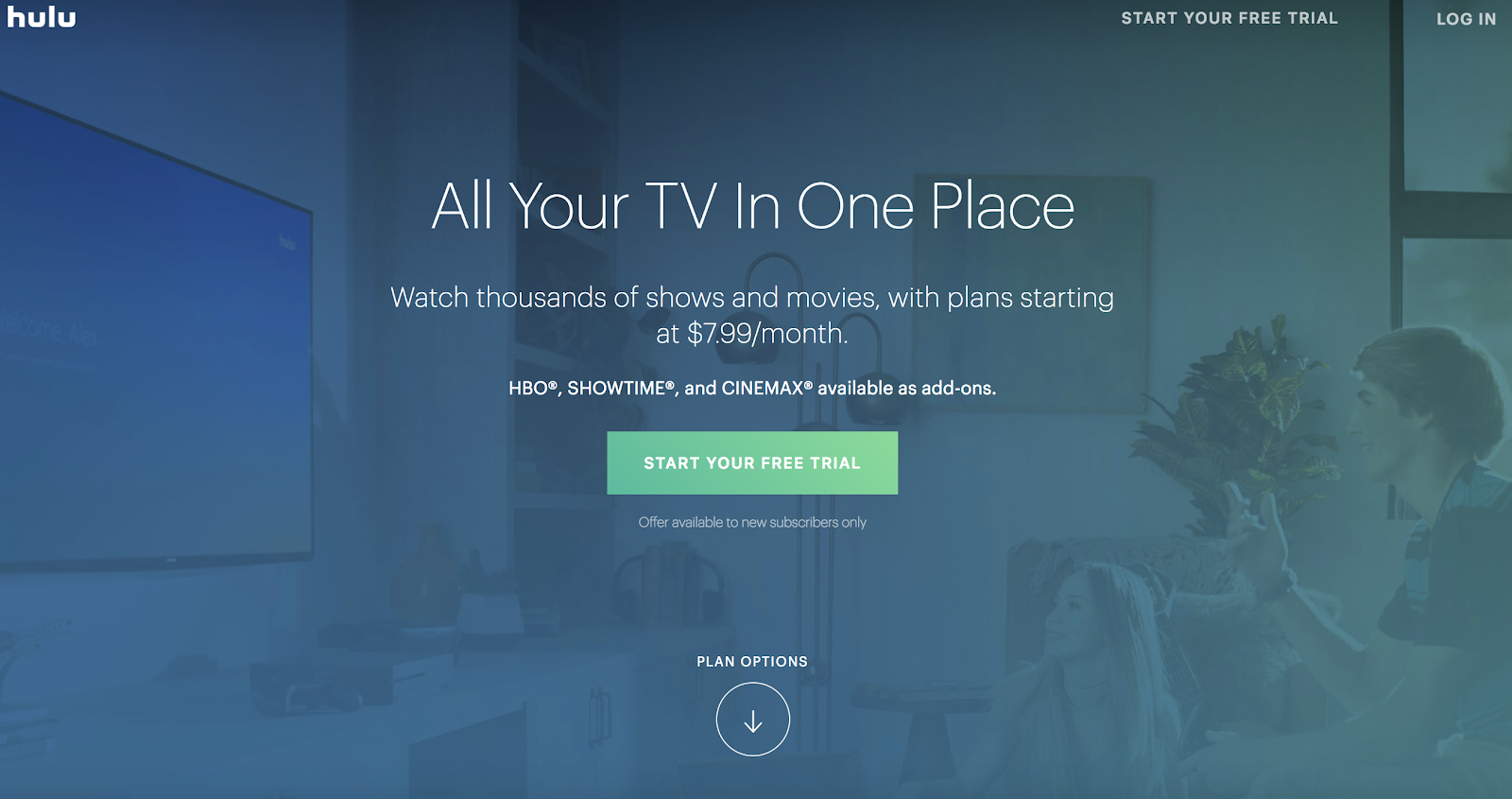
This is a beautiful design. The copywriting is compact and effective. The page has no purpose beyond getting you to join, and the page’s copy and design support that objective.
The CTA is the first thing you see, and the only thing you have to read. If you already know about Hulu, click the button to get what you’re after. But if you’re not clear about Hulu, or not ready to commit to a subscription, it’s easy to see what to do next.
There is one clear CTA and it dominates the page. Everything supports it.
Everything except for the other instruction and the arrow, and somehow they manage to be both noticeable and completely undistracting.
Isn’t the first rule of web design, Don’t make me think? It should be.
If it isn’t already tattooed on your psyche, let’s sear it to your brain: Don’t make your site visitors think! It is the absolute rule of a call to action (see next bullet for more).
Imagine that your users can’t figure anything out unless it is spelled out and decorated in bright flashing neon arrows.
Because otherwise, you might end up like a government website (oh no!).
I’ve chosen a few government websites to make this point because government websites are, historically speaking, the worst.
Take Medicare.gov as an example of you should absolutely never do if you ever hope to have a successful business (or government entity).
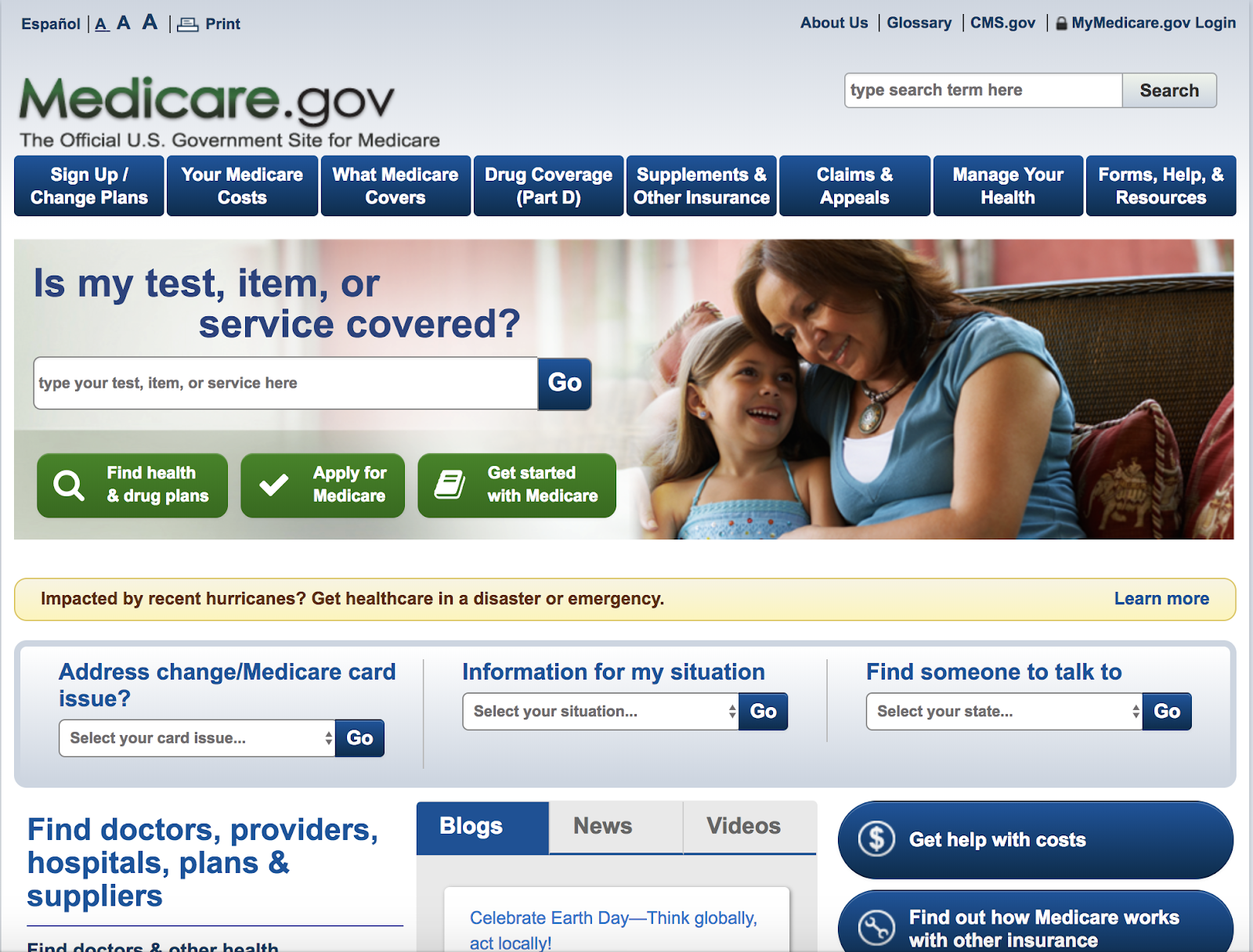
Why do I feel like this website it simultaneously yelling at me and beating me with fake feather pillows? I feel assaulted and confused and ready to flee.
You created your website to drive a certain action (like getting money, for example). There’s one you want more than all the others, so make that one the most obvious–make it the shiny red button that says PRESS HERE.
This site has no button. It has no sign posts, and suddenly I’m lost and forgetting why I came here in the first place….
And just as I was getting frustrated and beginning to orient myself, I got a pop-up. How many problems can you point out?

If you care at all about your site visitors, if you want your business to be at all successful, don’t be like Medicare.gov. Help your visitors get to where they want to go.
And don’t give them “Next Step” without telling them what the next step is. I want to at least know where my information is going.
We can all agree that medicare is kind of a disaster, but there is hope, even for government websites!
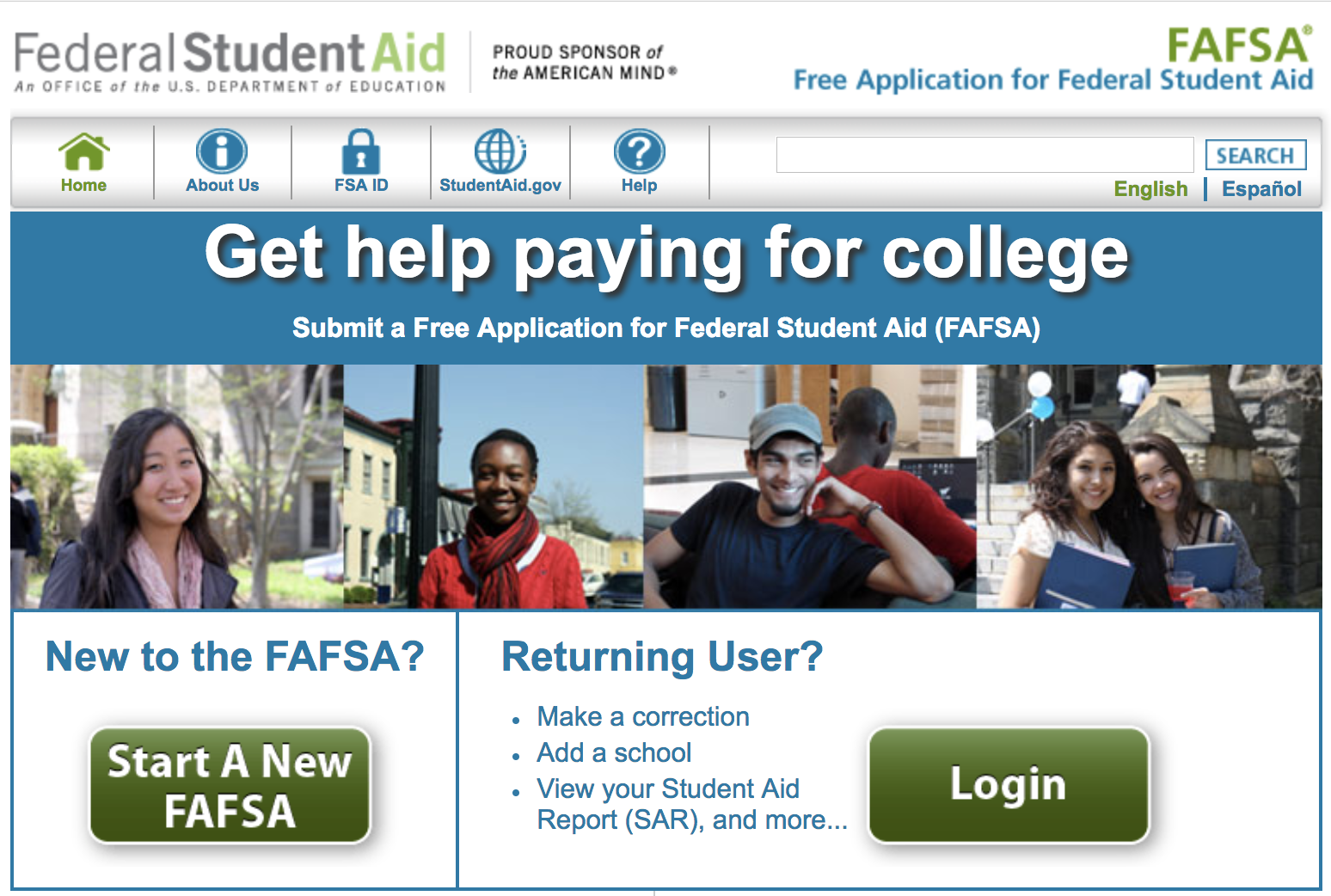
In fact, here are two other federal websites that, love ‘em or hate ‘em, are beautifully-crafted with clear, effective, compelling calls to action.
 Ah,
Ah,
I’ve talked in this piece about having a single CTA. But what about having two?
If you can do it as effectively a these guys, proceed with two. Notice that they followed all the rules. Their buttons are pushy; page hierarchy, color, and design points you directly to the buttons; you don’t have to read anything else to understand what the buttons do.
Important note: Limit your options to two. I have yet to see anyone pull off 3 options effectively. Why?
It goes back to our rule up top: don’t make people think. Picking between two options is pretty easy, but three requires some decision making, and that scares people off. Make it simple, clear and easy.
I signed up to do surveys for WNYC , which does some really great podcasts. I love public radio. I want all stations to make great programming and to get lots of listeners.
And so I want to point out a few things that WNYC–and any other stations seeking feedback–can do to be more effective.
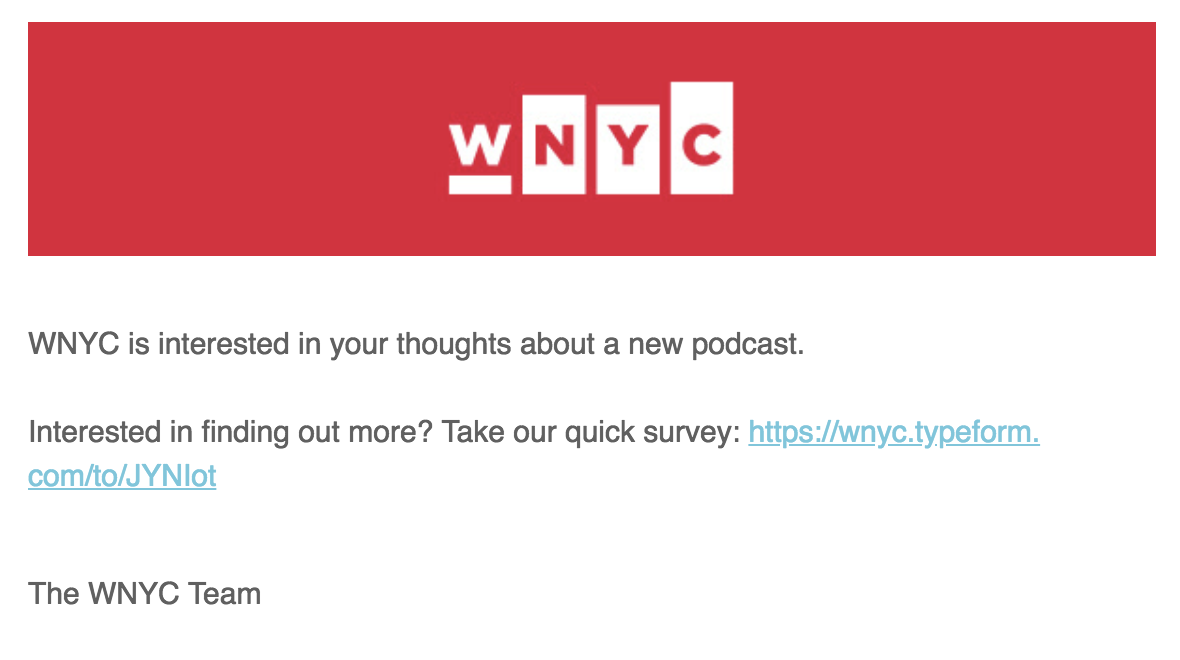
You have a cause, WNYC and other radio stations. I want to be a part of it–that’s why i signed up tfor your surveys.
Just because I signed up doesn’t mean I’m going to take your surveys, though. It’s the internet and I get distracted. Keep me engaged. Keep rallying me to your cause. Keep showing me it’s worth my time to help you. Make it easy for me. Make it so easy that before I can think about not doing it, I”m already done.
Now get some sharp copy and a shiny red button.
Email marketers know where it’s at. They have to. They depend on you opening their emails. When you unsubscribe, they lose a customer.
As a result, they’ve got the CTA down to an exact science. The best emails are image-heavy, perfect for skimming, easy to click.
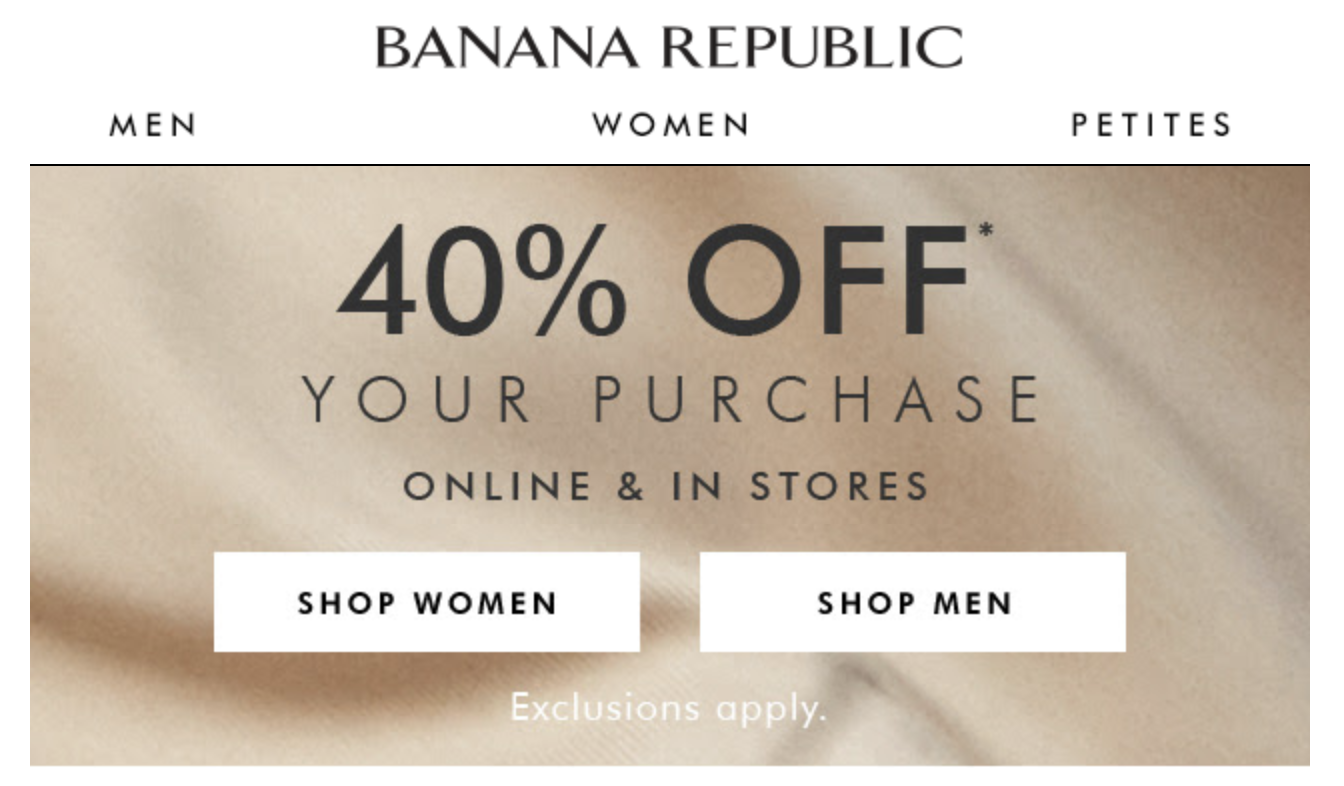
This one from Banana Republic puts the cause front and center (40% off) and gives you two options. It puts the fine print in white which obscures it just enough to keep you focused on the shopping.

This donate button is from a political campaign. I didn’t bother reading the preceding text, and I don’t doubt the email was designed that way.
For those who needed a little convincing, the campaign offered a cause to get behind.
For those already convinced of the cause, they got right to the point.
It’s the perfect button. It not only calls me to action (donate!) but tells me how much. I was worried about how much to give, but now I know that $3 doesn’t make me a cheapskate.
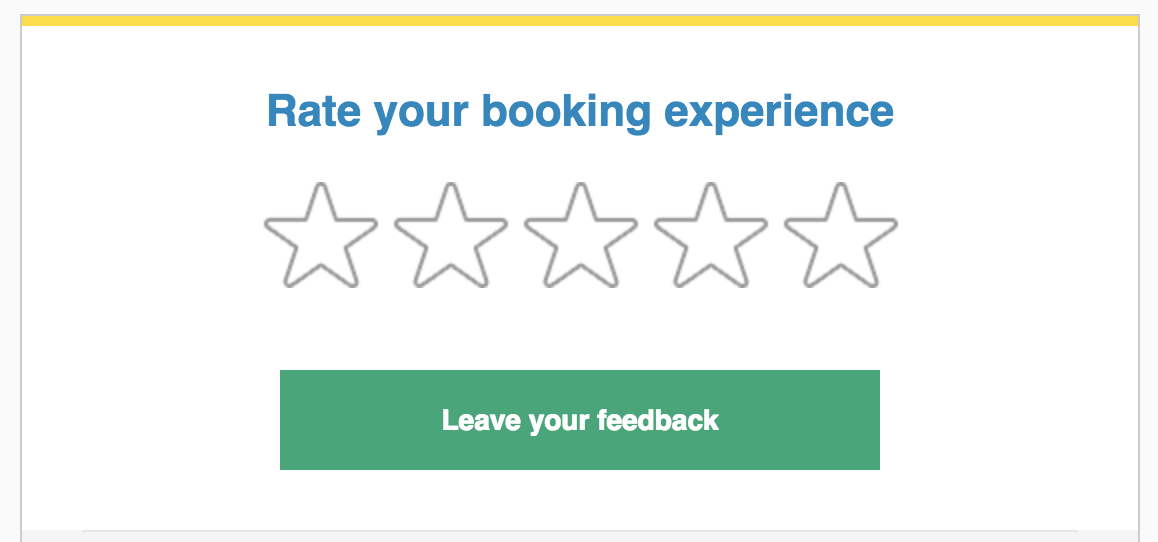
WNYC, I hope you see this one. The booking site wants my feedback, but they know most people have no incentive to give it. So what have they done?
“Leave your feedback” is a straightforward invitation–I know exactly what it means–and if I don’t feel like accepting (many won’t), they still get the feedback they want.
You know why you started your business. You know all the good it can do for your customers.
Now get out there and tell them about it.
SXSW is in town March 9-18! We’re shining a spotlight on four speakers and their work that revolutionized our world.
I think of Amber Venz Box is smart, savvy, and fashion-forward. In 2011 she leveraged her love of–and good taste in–style and disrupted the retail industry and transformed fashion blogging into a serious money-making machine.
She founded rewardStyle, a platform that allows select (it’s invitation only) fashion, beauty and lifestyle influencers to earn money for the sales they, ah, influence.
She also created LIKEtoKNOWit, which you’ve no doubt seen hashtagged on Instagram. CNBC reported in November that rewardStyle influencers have generated over $1 billion in global retail sales. With LIKEtoKNOWit, the double-tap of an Instagram picture (ie “like”) sends an influencer’s complete outfit details direct to your inbox. Its influence reaches far beyond Instagram (including a deal with Google) and has generated over $700 million in sales.
The best part: Venz Box’s platforms have given thousands of women the opportunity to launch their own businesses. Fashion blogging began as an industry that offered little more than bragworthy perks. Now through affiliate marketing and Venz Box’s platforms, these influencers can earn an easy 6 figures.
She’s given women (because influencers are overwhelmingly women) an avenue to start and run their own businesses, no MBA or corporate drudgery required. Retailers profit, followers are thrilled, and women around the world build thriving businesses.
3 Business Lessons From Amber Venz Box:
It’s easy to get caught up in “figuring out” what to do with our lives, what business to start, how to make money. Venz Box focused on what she was really good at and getting it out in the world.
EveryDrop Filter 1 reduces 24 contaminants, including pharmaceuticals, waterborne parasites, lead, pesticides, asbestos and industrial chemicals (NSF certified). Certified to fit these leading refrigerator brands: Whirlpool, Maytag, KitchenAid, Jenn-Air and Amana. Used in side-by-side, top freezer and bottom freezer refrigerators. In the side-by-side refrigerator, the filter compartment is in the top right corner, or in the bottom left grille. In the bottom freezer refrigerator, it’s in the bottom left grille. For the top freezer units, it is in the middle of the refrigerator. Replace filter every 6 months or 200 gallons to maximize contaminant reduction.W10295370 Replaced model w10295370a
Enjoy fresh, filtered water and ice from your refrigerator w10295370a Filter 1 is certified by NSF to reduce 24 contaminants – including pharmaceuticals, pesticides, waterborne parasites, lead, asbestos, and industrial chemicals in addition to providing great tasting water by reducing the presence of chlorine
Each filter provides 200 gallons of filtered water and should be changed every 6 months to ensure proper contaminant removal and flow rate
Reduces 24 contaminants
NSF certified to reduce the most contaminants
See Amber Venz Box March 12 @ 12:30 PM
Let’s build the solutions your business needs to grow.
Book a strategy callLet’s build the solutions your business needs to grow.
Book a strategy call