Automate. Improve.
Increase Revenue.
Let’s build the solutions your business needs to grow.
Book a strategy callYes, so you have come up with the brilliant idea of a new software, a business solution or an innovative product that no one else has thought about and you are now thinking how to go about creating your own startup business. How do you get your idea off the ground? How do you tell people about this new exciting idea when you really don’t have the money to do so?
The mistake many start-up owners make when working on a tight budget is that thinking that they have to slice their budget. Most often, they believe that if anything needs cutting, it has to be the marketing expenses. But this is not the only option.
Yes, it is an established fact that the traditional way of advertising is costly and very hard to measure. However, your small business can survive on a tight budget, even with so many other successful and established players in the market.
All you need to do is utilize low-cost or free platforms to influence enthusiasm around your idea. Use your time and that of your initial employees to generate that enthusiasm. Many small start-ups have learned to combine Social Media and Email Marketing to push their business forward and you can do the same.
In this article are ten effective marketing strategies that you can use to help you push your business forward even when you are working with a limited budget.
Marketing should be constant – make marketing your goal anywhere you are. That’s why it is so important to have a winning elevator pitch.
Research has shown that an adult has an average attention span of 6-8 seconds. Only just 6-8 seconds you have to hold someone’s attention. Once you engage them, you have only a limited time to sell them your product or service. Spend your time creating an appealing elevator pitch. This will allow your business to benefit greatly leading to a massive growth in business opportunities.
Your community plays a crucial role in your marketing strategy. Find out what’s happening in your community. Sponsor a community event such as a 10k walk /run or a Little League team. Why not print some bookmarkers and place them at the library in your area? Check out your ideal customers and find out where they spend most of their time and what they love doing.
Now you are in a position to look for ways to get your marketing message in front of your customers.
Why not join forces with other supportive, non-competitive businesses in your area and cross-promote? Use fliers, coupons, social media platforms, bundled promotions or shared website links to promote your business. Teaming up with other companies will help you reach more people and so will lead to an increased customer base.
Networking is a great way to promote your business. It allows you to get out there, meet people, and get to know them. Networking does not provide immediate gratification because it needs time and commitment but if you build a strong one; your business will be heading in the right direction.
Many persons shy away from public speaking. Numerous organizations need persons who are qualified and competent in relevant subject matter to make presentations to their groups. Why not ditch your fear and volunteer? You don’t have to be an expert to speak, you just need to share information that is relevant to the audience. What are the benefits? You gain confidence the more often you speak, while at the same time you are building your credibility as an authority in your field.
Create your own buzz. You can get a lot done without contracting the services of a professional company. Resources such as Help a Reporter Out are available. Check out and respond to queries made by reporters who need resources and story ideas. While a few are small media prospects, others are large media outlets that use the services. In time, your brand will create its own buzz.
Referrals make it easy for new customers to get in. Many people are eager to provide referrals if you ask them to, but some will never do it on their own. Don’t miss out on the opportunities by not asking for them. Promote your brand by asking your customers for referrals!
Building relationships is great for your business. It is crucial that you establish strong relationships with your customers and email marketing is the ideal way to do this.
When you ask customers for their email addresses whenever they visit your website or store, you are creating the way to communicate with them. Just provide useful, informative and professional communications that will make them want to keep doing business with you.
.9. Give out coupons
Coupons are great for attracting new customers. Research has shown that many people will use coupons to stretch their spending dollar. Then why not use this method to expand your customer base? They are great for generating return visits, especially when you give them as incentives to use on future purchases.
Giving out samples or free trials is another way of increasing your presence in the market. People these days are more likely to buy a product or service they have tried before. Therefore, provide the opportunity for people to experience your goods or services.
Conclusion
Your start-up doesn’t have to fail because you have a limited budget. By using the ten listed low-cost marketing strategies you will be able to engage your customers, build relationships, and eventually keep your product/service on top.
When you need to utilize effective marketing strategies to grow your business money is not necessarily the key factor. What really matters is the time and effort you are willing to spend to make your business successful, but most importantly, is the relevancy that all this has for your customers.
It’s impossible to identify a winner or at least to complete a competition if there isn’t a finish line. Namely goals (short- and long-term) make measuring the success possible and help to avoid or amend failure. Implementation of online marketing strategy, like any other sphere of your business, needs a precise set of steps that include short- and long-term goals and objectives.
It may be difficult for business owners to look at their business from a new perspective. In this case an experienced web design, SEO and internet marketing firm can help them to establish marketing goals for all activities of online promotion such as official website, blog, pages in social media, etc. Profound understanding of the matter and the costs of achieving the goals will help to save you time and resources.
You need to set goals for online marketing and its objectives because they predetermine a purpose and potential result of all online activities. Goals and objectives together make change and adaptation possible so that they can provide a way of measurement to help scale your business marketing efforts The most popular goals must:
You can modify or eliminate tasks that do not support your goals. This frees up time and other resources to focus on activities that do support established goals. This is a cost-effective and efficient way to organize multi-faceted entities such as online marketing.
First thing you should do is write out all your short-term and long-term online marketing goals which must be laconic, clear, and have only one interpretation. On the next step you should determine the attributes of each goal as what, where, when, who, why, and how. This step helps to assign all tasks to the members of the team who will cope with them in the best way, so every member of the team knows his/her role in achieving the goals.
Short-term goals are the goals you want to do in the near future (days or weeks). Long-term goals are those that take a longer time to achieve (several months, a year or several years). Both of them play an important role in success of online marketing.
We can call long-term goals most meaningful and important because they determine directions of online marketing. They often represent general ideas and aspirations, such “Become one of the top-ranking door-to-door moving companies in Austin.” Short-term goals should be considered as supportive goals. These goals usually support big ideas of long-term goals. For instance, “Produce three optimized weekly blog posts about relevant life coaching topics.”
As a small business owner you should make your long-term goals clear. Some examples of long-term goals for an online marketing campaign may include:
After the establishing of long-term goals you can start to work on setting short-term goals. You can use different ways to determine the most important short-term goals such as internal company surveys or brainstorming.
Company’s short-term goals can support its general long-term goals, or exist separately. Examples of short-term goals of online marketing include:
Every step of setting of short-term and long-term goals should harmonize with your company’s general marketing strategy, goals and objectives. Every task should work in harmony to support your company’s marketing goals and objectives. At ATX Web Designs, we assist new and established businesses in developing short- and long-term online marketing goals. We also provide specific, measurable ways to track your progress. Learn more about how we can help you streamline your online marketing efforts. Call 512-994-0191 or contact us or more information.
In today’s society, social media sites are a huge contributing factor for sales. Facebook, is especially great for small businesses to generate new leads and build their online presence. Why? Because potential customers spend most of their free time online. According to Social Media Today, the average person will spend nearly two hours on social media every day!
How do you know what type of customers you’re attracting to your Facebook page? Well now there is a new easy tool to use that is called “Facebook Insights”. It has the ability to show you all kinds of statistics about how your Facebook business page is performing. I know you’re probably thinking I’m about to give you the “sales pitch” or be told the elongated “too much information” spill. Surprisingly no, I actually have simplified and highlighted a few of the essential benefits that Facebook Insight has to offer.
If you’ve been actively marketing your business online, you’ve probably familiar with both local SEO and organic SEO. But you might find yourself wondering what’s the difference between the two.
No worries. We’ll discuss the difference between local SEO and organic SEO and how they relate.
They both begin with search.
The main difference between organic and local search is that local search has a physical location component. If a user searches for your industry plus a specific location, the search engine knows there is a local intent in that search. Search engines job is to give the user exactly what they’re searching for. Here’s an example of how local search works:
You want to get your kids involved in some after school activities. You hear karate is good to get them involved in so you Google search “Karate Class Round Rock.”
So what’s it going to be? As you see, only three karate places show up in the local results under the paid ads on the first page.
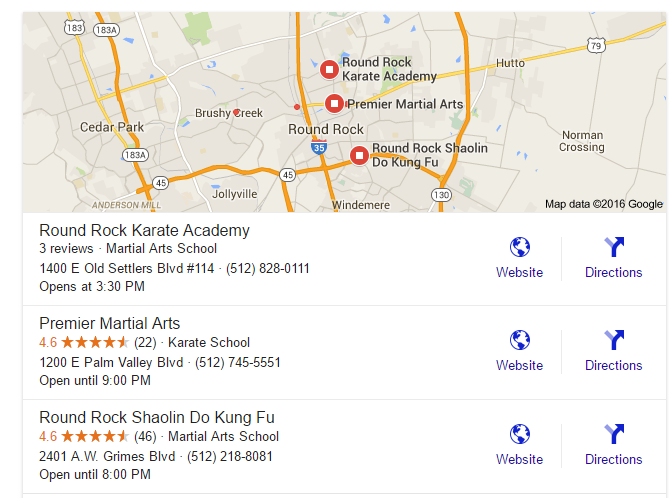
Even when searching for “Karate” Google assumes I’m looking for a nearby karate class.
If you look below the local results, you’ll see what are called the “organic” results. These are the results search engines return on searches that they don’t see as having local intent.

Organic search happens when search engines decide there’s no local intent in the search. The searcher is looking for information rather than a specific location.
Maybe you want to teach your child some self defense moves yourself. So you search for “How To Do Karate” and the search engine will pull the best and most relevant results for that keyword.
So, you might be wondering how search engines determine which karate places (local results) or how to do karate (organic results) are the best or the most relevant.
Search engines use hundreds of factors to rank and index websites in searches, including keywords, outbound and inbound links and even grammar, just to name a few.
Brick and mortar businesses with physical locations will want to rank high in a local search. Your target audience is likely looking for a place to go for a specific product or service. Therefore, your local small business needs to show up in local searches for your industry.
On the other hand, if you want your business to show up for certain search terms including or not including a specific location, you want to try to rank higher in organic search.
For example, if you sell art online but your business has no physical location and doesn’t serve a specific area, you want to show up in organic searches. You can still target a specific location or area, to potentially capture customers in your area.
If you have a business with one or more physical locations as well as an online store, you want to be found locally as well as organically. You also want to be found both locally and organically if your local business has a blog.
That’s where organic SEO comes into play. Search engine optimization is the process of trying to make sure search engines know which searches your business or website is relevant for.
To rank higher in search results, both organically and locally, your business has to be relevant to a specific search. And to show search engines your business is the right answer for a particular query, you have to state the obvious.
It’s important for your business to show up in relevant local searches because over 50 percent of searchers visit businesses within 24 hours of a local search.
Naturally, optimizing a business for local search has more to do with location than with other factors. Search engines need to know exactly where your business is located so that when someone searches for a location, the search engine can find the businesses located in that area.
For local search, you want to make sure your business name, address and phone number is consistent across local listing directories as well as your website. That’s the bare minimum you’ll need for local SEO.
This has less to do with location and more to do with whether or not your website is relevant for certain keyword searches. That’s why “karate” and “how to do karate” are in bold in the “how to do karate” Google search. When searching for how to do karate the search engine wants to give me video and tutorials on how to do karate.
When optimizing a website for organic search, the intention is to get the website to show up for certain keywords. This could be a short term “how to do karate” or a question spoken into voice search on a smartphone. “how to teach myself to do karate?”
For organic SEO, you need to use specific keywords in headings and paragraphs. Don’t stuff the paragraphs full of keywords, but if you post a tutorial on karate, you might want to use the words “teach yourself karate” at least a couple of times.
There are also certain SEO practices that help both local and organic search rankings. For instance, when claiming your business page on local listing directories like Google, Bing, and Yelp you are also adding a link back to your website.
These local listing citations (your business’s name, address and phone number) help local SEO by telling search engines where you’re located. They create links back to your website, which counts as a link building strategy that helps your organic SEO efforts, since search engines take the number of backlinks into account when they rank websites in search results.
On-site local SEO, such as writing a locally focused blog post or updating a page by adding your business’s address can also help your organic SEO. Search engines like fresh content, so while local SEO helps send out signals of local relevance, it can also help boost your organic SEO efforts.
When they’re done correctly, both local and organic SEO efforts will help improve your website rankings, but when done incorrectly, both can have a hugely detrimental effect on your online marketing efforts.
Remember, even though SEO is optimization for search engines, it is what helps consumers find your business. While you want to make sure search engines know what your business and your website are about, it’s important to think of those potential customers who are searching for your business. Don’t just optimize so that Google knows what you do. Make sure your target market can find all the information they’ll need to know about your business, such as exact location, hours, services or products, and more.
Do you want your business to rank better in local SEO, organic SEO, or both? Contact us and we’ll give you more information on steps you can take to rank better in local and organic search engines.
Starting a new business can be very worrying. With so many plans to put in place and numerous decisions to make you have to be careful not to make the wrong choices as this can really work against your success.
While there are no surefire plans available to make your small business startup a success, you can avoid the mistakes other new business owners have made, which affected their businesses negatively.
Let’s look at the 10 most common mistakes you should avoid when you are starting your small business.
Planning takes time, but if you want to be free from the stress of a failing new statup business, you have to plan effectively. Your planning should include business idea, research and prospective target market, without these you will be left completely in the dark. There are three key plans you need to include before lauch out: business, financial and marketing plans.
Goals keep you focused and help you know where you are in terms of your daily operations. Simply put, your goals give you direction. Your goals help you recognize where you want to go and help you to pinpoint the particular steps needed to get you there.
Fear of failure and lack self-confidence in your ability can result in undervaluing of your products or services. Doing this is not good because it undercuts the true value of your business and makes way for possible frustration and bitterness. Moreover, it will take you a very long time to recover if you put too low a price on your goods. The best way forward is doing a thorough exploring of the market so you can identify the right entry price for whatever you are selling.
Technology creates new opportunities for new business owners; it makes your work easier and help you run your business more efficiently. New technology can be scary too, and may take some time to learn or understand, but failing to use new technology can hurt your business both in the short-term and in the long-term.
Marketing is a good way to get people to notice your business. Marketing can take many approaches including word of mouth recommendation, traditional advertising or internet marketing. Since marketing strategies vary, you have to find the one that is perfect for your business if you want your business to grow. If you don’t market your goods/services, you won’t be noticed.
One important key to a successful marketing campaign is the ability to understand an ideal customer. A market research will help you identify the persons you are targeting, where they are and the way they will respond to your marketing actions.
Many persons may believe that you need a large investment to start a business, but is not so. You don’t need to spend money purchasing the best technology, the best software or the best equipment. There are other viable low cost options. All you need is the willingness to make the necessary research. The best way to limit overspending is to make a business budget and follow through.
While the possibility exists that some small business owners will overspend, others will do the exact opposite. Being cautious about overspending is good but you must realize that for your small business to succeed, you will need capital. You have to strike a balance because underspending will only hinder the growth and success of your business.
While a Jack- of- All -Trades mentality may look like the right approach to a small business owner, this however can limit your success. Delegating some of the workload will give you the time to focus on those activities that need your required expertise. Building an efficient and reliable work team will position your business for long-term success.
Character traits such as determination, dedication and commitment are key to getting your new start up business off the ground. As a small business owner, you have to be prepared to face the challenges directly, make the necessary sacrifices, and fill in the time needed, if you want your small business to be successful.
Making mistakes is a common everyday experience. The most important thing about the mistakes we make is accepting them. Accepting your mistakes makes you aware of the importance of working on them consistently. This will help you make the right choices to push your business forward. Being resilient is the only way to bounce back from your mistakes and attain the level of success that you desire.
What the heck is a landing page, and why do I need one? A landing page is a web page that is designed to motivate a specific audience to visit your website. The link to this page is usually presented in direct mail, emails, Facebook advertising campaigns, pay-per-click ads or social media posts. Basically, your landing page should get visitors to subscribe, fill out a form or contact your business.
So, what’s the difference between your website and your landing page? Well, even though they both generate leads for your business, your website should be designed to provide details, improve your business’ online visibility and display case studies. A business website, that is well designed, directs your visitors to take certain actions.
Your landing page, on the other hand, is designed for a for one specific audience. The benefits it brings makes them perfect for driving leads. Here are 7 things a landing page can do for your business.
Researching a fresh niche? Promoting a recently launched product or service? Just need more customers? How about increasing your sales? That’s where a landing page comes in. Whatever the goal your business needs – landing pages are the way to go. They can be targeted to a specific set of people and you can measure how successful you are in achieving your that goal.
When we say specific, we mean nitty gritty specific, the kind of specific that you can’t design a website for. The actions you can lead people to take include providing contact information, subscribing to your newsletter, purchasing, requesting consultations, or signing up for a mailing list.
In the same way that your website can move a visitor to perform a certain action, so can your landing page. Your landing page pushes a call to action. It defines an action that you want your visitors to take and presents it in the easiest way possible. Your business benefits from more conversions, since conversion generally leads to sales and sales means more cash for the business.
Linking a landing page to a particular action, source, content, or campaign can show you the channel that generates the most leads, the offers and topics that interest your audience most or the best performing campaigns. You can track your visitors behavior. This allows you to scale your target market, as well as your campaign strategies, making you more effective.
Implementing A/B testing also helps gather more insight. You can use several landing pages over a period and determine the effectiveness of each. They need not be drastically different. You could possibly use a different video, different text, layout, colors or even vocabulary. In this way, you will see what works for your business and what doesn’t.
Paid search campaigns depend on click through rates. What better way to increase your click-through rates, than with a landing page? For instance, let’s say your business is a shows in search results when an individual searches for “kitchen design” in a search engine. You could direct them to your website’s homepage or another webpage within. However, your homepage gets individuals to your site. A landing page quickly turn that visitor into a qualified leads.
When you have a landing page designed particularly for a certain ad campaign, it will direct visitors to one webpage. This page will show them what they are interested in, making it more likely for them to contact your business or complete your form, and voila a new lead. In view of the fact that the user has found exactly what he/she is searching for, and the landing page takes them closer to their ultimate goal, there is an increased likelihood of the visitor clicking that link and going through the steps.
Compare the above, to being directed to a webpage that has general information that may not even present a clear path to the information that you desire. Ah! Other links may divert your visitors’ attention or they may get overwhelmed by the information, reducing the likelihood of them contacting your business and becoming a lead.
If your landing page is meant to generate leads, that is, get you form submissions or phone calls, it may have a form, or a link to one that collects the visitor’s company, email address, name and/or telephone number. A form that requests an email helps to grow your mailing list.
Upon completion of the form (or somewhere in it), you can have a button or checkbox that allows the person to indicate whether they would like to get offers and emails from your business and also what kind. Then, you add the persons, who have indicated, to your list for announcements, news, promotions, and sales (linked to other landing pages) to make sure that your business is informative and current.
Content and elements on a landing page can be optimized to achieve the particular objective or task or to direct the user in the path that it is geared towards. Setting a clear course of action for your users and assisting them on that path lets them see that you understand their problem and you have spent time thinking about and designing the most suitable solution for them.
If that isn’t enough, show them what other people have to say. Testimonials on your landing page about the focus service or product are an excellent way to go. Your customers are sure to feel more secure knowing that your solution has worked for real people with real problems, similar to their own.
Ensure that your landing page has consistent branding. That way people readily recognize your brand when they see it. The landing page should look like something they have seen before that is associated with your brand whether the content, feel, layout, look or style.
It should especially resemble the page that it links to. This benefits you by ensuring that user engagement opportunities with your brand are increased. Their familiarity with your brand grows. This is especially important in light of the tendency for clients to purchase products or use services from businesses they know or have seen on a regular basis. Ensure that they remember your business.
To top it all off, landing pages are designed to influence user actions with regards to your business’ goals. They assist with improving your customer relationships, how successful your marketing campaigns are and how much you know about the kind of people your business attracts. Landing pages are for a developed for a particular target audience, and to capture them and turn them into a lead.
Definitely test out a landing page in your next marketing campaign and see the results!
Many small business owners at some point in the past 10 years, sincerely believed that they did not need to marketonline. Nowadays, most of those small business owners have given in and gotten a website at the very least but that is just about it. Do they give thought to search engine optimization? What about branding or even offering a platform for e-commerce. How about using social media to engage customers?
“Traditional” business owners may see these things as fads or time wasting pursuits. True, these things do require a bit of time, money and effort. However, the professional and more up-to-date marketer sees the obvious benefits. Why though do views differ when it comes on to online marketing? Is it really necessary for small businesses in this day and age, or is it possible for small businesses to stay afloat and thrive minus the online strategy?
Why views differ?
There are a plethora of reasons cited by traditional business owners to support their claim that online marketing is not necessary or doesn’t really add much. Not all business owners who don’t see the need to market online have the same reasons.To be fair, some of the supporting points they raise bear merit, but others can be easily set aside when the facts are carefully considered.
• All my customers are offline.
Businesses that gain their customers through networkingandexisting partnerships often believe and adhere to this statement. While this is true, they fail to consider the fact that the reach of their existing marketing strategy would have to be offline if they are marketing offline.Putting things into perspective, of the 5 billion searches on Google daily and the excess of 1 billion active users of Facebook, even a few must have some interest in your business.
• My business doesn’tneed more customers.
This reasoning is a bit difficult to argue with. We all know that thereis always room for improvement. True, you may not want to have the added responsibility that goes with expanding your business. It’s great if the customer base you have is satisfactory and profitability is at the point where youhavenoreal interest in growth. However, you need to be sure that you can depend on those customers to support you in the long run.
• Marketing onlineisn’t effective for my business.
If you have attempted marketing online before and were not successful or not as successful as you expected, that doesnot mean that marketing is the problem. Rather, the issue could lie in how it was designed or executed. Don’t for once think it is a small business thing, it happens even to the best. What you need to do, is to improve your strategy,pursue new channels, secure new partners, broaden or better focus your target and increase the accuracy of the data you use.
• Online marketing is a fad
Online marketing is definitely not short-lived. Types of marketing online or off can be fads. However, most of the established fields of online marketing have survived for over a decade. Instead of fading away entirely, they may change their form. That still is no excuse to avoid joining in to get your share of the patronage.
•Online marketing is too costly. The approach that we take to marketing may cause us to see it as another expense. However, marketing is an investment. If you do it properly, you will get back way more than you put in.
• I don’t understand it. Not understanding online marketing now doesn’t mean you won’t ever understand it. Research is so much easier with ready Internet access and online communities that can and willassist you to understand. Otherwise, you can hire an agency orcontractorto provide designing, execution, and management services with regards to your campaign.
Having broken down most common objections, here’s why you need to jump into online marketing sooner rather than later.
Consumers Expect You To Market Online.
Generally, when we first hear of a business, most of us will immediately search the internet for a social media page orwebsite to either learn more or find out if such a business really exists. Stopping in for a visit doesn’t cross our minds. Neither does searching a phone book (unless it’s online or an app of course).By default we and by extension, people expect that you to have a website; if you don’t, this casts doubt on your legitimacy as a business or you get relegated to the bottom of their list of available options.
Bottom line: Consumers expect to find you at least mentioned somewhere. Reviews and listings in online directories are good. A search engine optimized website and blog are even better. Couple that with a Facebook page and pretty soon you’ll be thinking e-commerce.
Online Marketing is Always Available
Continuing on the above point, let’s say persons were willing to call your business or even stop for a visit. Unless you are a 24-hour business, you can’t always be available. That’s where your online presence picks up. Customers can still be engaged and get some questions answered while you remain undisturbed. If they forget to visit your physical location, let’s say, to find out the products you offer, your online marketing strategy can do that for you wherever they are at whatever time they want to know.
Keeping Up With or Staying Ahead of Your Competition
Not every business owner will share your reluctance to develop and execute an online marketing strategy.Who knows if your competitors aren’t capturing your more tech-savvy customers?What about “robbing” you of your prospective customers and giving a better first impression to just about anyone in search of businesses like yours in yourlocality. If they already have, every day you delay an online marketing strategy of your own is one day for them to increase their lead.
Rate of Change
Change and trends are usually the biggest factors in determining what will work. Technology is readily accessible and it is used without a second thought. Reliance on online services and stores is also on the rise. Dependence on the Internet increases with its speed and the improvements on mobile devices and dependence on physical structuresare on the decline.Consequently, as time goes by, online marketing’s importance increases consistently. You may not see it now but what of next year. Remember this investment is long-term.
At the end of reading this, you may still not think you need online marketing and you may be right.If you don’t have any kind of online marketing going, you are blocking your potential and maybe even setting yourself up for collapse in the future. Your business may be doing well without an online presence; this doesnot necessarily mean that you are better off. You won’t regret your attempts at online marketing.
Most business owners put their focus on usability and a good design when getting their website started. They put emphasis on generating web traffic, marketing their site through various means like social network campaigning and cold emails. While these are important there are a few other things to consider.
For one, you want to convert. That means you want visitors to your site to take some sort of action. This is for more reasons than one. All your efforts are useless if the persons visiting your site don’t make a purchase, sign up or subscribe to your mailing list. Not only that but they increase your website’s bounce rate which lowers your SEO ranking causing search engines to think that it is not relevant to the keywords that itis indexed for.
When you are doing a website for your start-up you can’t spread yourself thin applying every piece of advice that you get. There are some things that you can’t afford to overlook. Here are 5 of such. You can always research and at to the list.
1. Ensure your value proposition is communicated conciselyand clearly
At the top of your priority list of things to communicate is the list of productsand/or services that youoffer or will be offering. This information should be communicated upon visitors entering your site. You may choose to use a short title that isa simple statement with a subtitle to give more details.You may favor usingvideosorpictures,just keep them to the point and your message clear. A value proposition is by no means a slogan.It basically sums up the problem you offer a solution to, the way you are able to achieve it and why they should choose you.
Youalso need to draw attention to your value proposition.From time to time you may want to change the presentation style, although the statement may remain the same.
2. Have a clear call to action
The Call To Action is theimage,button, or link that you want your visitors to click to be well on their way to becoming a customer. For eCommerce sites, the checkout or add to cart button would be the call to action. For marketing or service sites,the subscribe or sign-up button or linkwould be the most likely choice.In the early stages of your startup and for your blog the Call to Action would also be for them to subscribe to your mailing list. The call to action needs tostand out, be easily identifiable and located in different sections of your website.
Your choice of images,text, and videos used on the website should be in support of your value proposition and move your visitors totake your desired action.
3. Have good web design and give users a great experience
It should be a pleasure for users to interact with your site, not only because of the beautiful things you have filled it with but, also because of the way your site works. The aesthetics should be on point but your site structure should be easy to follow and navigation should be easy as well. You need your visitors to understand and believe the value proposition that you have sold them. Youalsoneed to build credibility and get users to trust you and if everything works and feels good, you will speak to at least 75% of your website’s visitors.
4. Complete contact information
We tend to overlook the value of this until we are in a bind, need to get in touch with a business and we can’t seem to find their number or email address listed anywhere. Nearly all visitors may need to see your contact information at some point in time and even if they don’t need it, some will notice that it is not there. When your contact information is on your site, this helps your customers to see that you are interested in them and helping them solve any problems they may have.
You may want to consider having a separate contact page or includingaddresses,email,links to social media profilesandphone numbers in the footer throughout the site.
5. Clear, convincing and well-written texts
A good choice of words,correct grammarandaccurate spelling are vital. The textual content on your site that you use to sell your service or product is termed copy. They should put the meat on the bones of your value proposition. In the end, you really are trying to influence the visitor to decide to purchase from you. You may want to engage the services of a professional,experienced copywriterto tailor your content to suit your target audienceand businesstype.
As you grow, you can focus on more things. These are pretty much the bare essentials; what you need to start with. Anexcellent SEO strategy is important, but it is most effective, when you get the resulting traffic on your website, engage the visitors and use the means at your disposal to convince them to become a customer or at least consider it.
One of the most exciting experiences is planning your own venture and seeing it come to fruition. After you have gotten it off the ground, you recognize the importance of marketing. At which point, you may begin to wonder about the best way to reach the masses, drive results in your business, make your business resonate and being wildly successful, fulfilling your dreams on a very small budget?
Consider why start-ups need to be marketed. Start-ups are designed to create solutions to problems their users face. In order to connect with the right users, those who want to utilize your services or products, you need to market personally to them.A start-up needs its own brand identity in this competitive and fast-pacedworld sooner rather than lateras slow growth can prove damaging.
Then too there is traditional marketing. You may be wondering why we recommend usingdigital marketing as opposed to traditional marketing methods. The first and most important factor at this point is cost. You are able to have a wider reach and focus on those who are most likely to use your services without spending large amounts. This targeting prevents wastage and you are able to make digital marketing work on almost any budget.
How though can digital marketing be of assistance to you? Digital marketing helps increase awareness of and positions your business and brand. You are able to build a steady stream of trafficand get the first few users. Marketing digitally also drivesonline salesandleads.
Although there are budget and possibly time constraints within a start-up, they must have a few tools or techniques that can be leveraged at a minimal cost. Here are a few of these tools and how your business cango about making use of them.
Search Engine Optimization (SEO) – Search engine optimization is cost-effective and provides a way to measure benefits that are for the long-term. The organic traffic (that is visitors to your site that are not directed there through paid means) and overall visibility of your site increases, the higher your SEO ranking is. A high SEO ranking builds your business’ credibility, is free branding and is able to work for you 24/7.
To increase your SEO ranking
*Design your site to be responsive (mobile friendly) and secure. This is of utmost necessity if you are engaging in e-commerce on the site.
* Make sure that all your pages are functional.
* Ensure that you use appropriate tags, headers, and descriptions. You may also want to do this so it is easier for users with special needs to make use of your site.
* Design your pages to load quickly. Pages to focus on would beyour contact page and any others which you anticipate high traffic for.
* Ensure that your site content is relevant, memorable and a talking point. That way users will talk about your site.
Content marketing – Creating and sharing materialthat stimulates interest in your products and services increases traffic, gets you more leads, and increases awareness of your brand. It also gives a good first impression and forms the basis for great relationships with potentialand current clients.
To make your content marketing more effective
*Publish relevant, informative and engaging content regularly.
* Come up with original ways to make your sales propositions.
* Start a blog, write stories, and collaborate with other publishersto publish your content and increase your market.
* Include user stories in your write-ups.
Social media marketing – Social media marketing is a very dynamic form of marketing. It can pull users in and engage them. It provides you with statistics and even detailed feedback straight from your customers in real time. It is cost-effective and helps give your start-up a voice. Not every social media platform is suited to every business or at least what you want to accomplish. Choose a platform in line with your business and your desired outcome. You can choose from Facebook, Google Plus, Instagram, LinkedIn, Pinterest,Tumblr, andTwitter.
What to do on social media platforms
* Think of why someone would join your community or want to follow you and post along that line.
* Don’t be anxious to put lots of content on at once. Post your first few pieces of content and watch the feedback.
* Respond to chat in a timely manner.
* Use features such as groups and add-ons effectively.
Email marketing – Email marketing is simple. It offers a cost-effective,and personal strategy that can be tailor madeand measured. It has been proven to generate high returns on investment (ROI). Email facilitatescommunication with any size audience. Thereareabout three email user accounts for allTwitter andFacebook user accounts combined.
Getting emailmarketing started
* Choose an email marketing service provider. You could try a do-it-yourself platform. Amazon SES,Aweber, Constant Contact andMailChimp are a few.
* Set up a calendar.
*Ensure that you are not always selling. Try to make most of the emails about free services.
Growth hacking – This is an innovative, low cost and relatively new alternative to marketingtraditionally. Your sole focus will be growth and everything you do will be geared towards that.
How to go about it
* Set up referral programs.
* Go with exclusivity.
* Offer a free service or product.
* Offer something that makes your product go viral.
Get the handle on these tools and techniques and not only experience the excitement of starting right but also the exhilaration of soaring successfully.
Growing a small business starts with ensuring that you build strong relationships right there in your locality. It is imperative that your prospective clients get an excellent first impression of you, so they will like and trust you.
The person or company a consumer chooses to purchase from is usually more than just an afterthought. Most people generally research a business that they plan to buy from. Your online presence, like a physical storefront, creates an impression in the minds of your potential clients. Unfortunately, many small businesses, don’t invest a lot of time into increasing their online visibility.
Research may turn up a few online reviews on sites such as Yelp. However, most times their businesses are not listed with Google My Business, their Facebook page is almost non-existent and often times they don’t even have a website.
Growing a small business starts with ensuring that you build strong relationships right there in your locality. It is imperative that your prospective clients get an excellent first impression of you, so they will like and trust you.
Below are a few of the keys to creating a local website to aid the growth of and help your small business flourish.
The contact information of the business should be located that customers are likely to see it, whether they are looking for it or not. When your contact information is visible in more than one place on your site creates the impression that you are open and readily accessible, should your customers require information or assistance. When persons are making purchase decisions, they are assured in knowing that you are available if they need anything.
Your readiness to be contacted, also serves as a form of quality assurance. If you are not willing to share your direct contact information you create an impression of doubt about the legitimacy of your business in the minds of your customers.
The extra effort that you put in to be accessible is also recognized and rewarded by search engines. Search engines like Google have been seen to give a small boost to those businesses with their contact information placed on the homepage, especially when that same contact information is also visible on online directories.
When building your site, you need to bear in mind who you are making it for. When purchasing your service or product, your customers will have to navigate through your pages, images, and choice of words.
Whether you are selling cars to the general public, packaging material to a local manufacturer or childcare products to parents, you have knowledge of your products, business, and jargon that your prospective client likely does not. If you immediately jump into talking about the pistons on an engine to the general public, you will lose them.
True, using the jargon does make it seem like you know what you are doing. At the same time, the customer really does not need all that information to come to an informed decision.
When your prospective client visits your website, they would like help to solve their problem. They have placed their confidence in your ability to take the information that they have provided you with and provide a solution that is tailored to them with the personal touch small businesses are noted for.
You also need to think about how your site is designed and the way in which your users will experience it. Be sure to factor in the impression that the website creates on your target market when designing with your locality in mind.
Avoid a site that creates the impression of a corporate level business as individuals may be intimidated or come to the conclusion that you are high priced. Instead, ensure that the language and funnel used moves prospects along to the section of the site that they need so they can obtain the information to deal with the problem facing them.
With the ever increasing pace of life, likely, a large number of your clients will be viewing your site on the go. Mobile devices are the media of choice to do this. Keeping this in mind when designing your site will mean that it will be responsive; that is changing the content to allow ease of reading and navigating minus the extra scrolling and resizing on any device that they use.
Asking your prospective clients to zoom in and out of pages and interact with tiny navigation buttons and links may be asking them to find some other business that is more convenient.
To keep your expense and effort within reason and practicality, you need to think about what would be most important to a client that chooses to view and interact with your site using a mobile device.
If you are a local restaurant, mobile users of your site would not need such information as your company history or your vacancies on the fly. However, they would likely need to information on your specials and general menu. Contact information is also among the things that any site needs to have readily available to mobile users.
Small and medium-sized businesses are lagging behind where mobile websites are concerned with nearly 95% not having a mobile platform. This represents an area where SMBs can get ahead and improve to stimulate growth and foster trust.
A lot of the online marketing done by small businesses is like a nine-day wonder. The enthusiasm to keep the website and social media page content fresh can wane after a while. Allowing the website design and language to become stale creates the impression of a business that is dated and behind time.
Let people see what working with you will be like. You want to create the image of being established and professional however you also want your prospects to see that you are able to relate to their problems and why it matters to them.
Better than any jargon, maintaining fresh web content relating to the problem(s) that your prospects face, helps distinguish your business as having the expertise and being able to furnish solutions.
When they see you address the problem, they become aware that they have access to resources locally to answer questions or provide some other assistance.
You are also able to use your web content on social media. Based on your prospects’ interactions, you can determine what is best to drive your ads. You may also be able to get a mailing list or just create a repository for those persons who need just need information.
Keeping your site fresh requires effort but it keeps your business current and is crucial to growing a local business.
There are many other things that you can factor into your website design. However, this list represents a good starting point on the essentials when getting your website designed. When hiring a website developer, these should be high on the priority list of keys to your website’s success.
Sometimes, in seeking to be a competitor with major players, you underutilized strategies that your small business can capitalize on for SEO and branding.
In the attempts to gain more visibility online, it is often difficult to be certain of the tools to utilize, the methods to target and measuring results effectively, particularly so, when you are consumed with your small business’ daily operations. There may also be budget constraints as well and so a limited margin for error.
All of the above added to the confusing nature of SEO, a field where many companies promise to improve your rankings, but very few able to achieve, often cause many small business owners to wonder about the direction to take with regards to their small business’ SEO. Let us explore some things you do not want to do as a small business professional:
It helps to have an area of focus when approaching branding. This area is typically called your niche.
You may believe that gaining ranking for as wide a variety of keywords as is possible would maximize your impact, as your visibility would be high for a variety of search terms. For example, if your business is a bakery, you might face the temptation to target terms like cake making, cake decoration, pastries, bakery, baked goods, cake delivery and so on.
While it is true that all those keywords apply to your business and the variety of keywords may cause you to rank for more search terms, your relevancy for each will be low. When competing with businesses with budgets that are lavish, have content the size of your entire site and a longstanding client base, your moves need to be more calculated and strategic.
Allocating resources to a few keywords, perhaps cake decoration, cake making, and pastries will increase the likelihood of you ranking higher for those particular terms.
In line with the first mistake, you not only need to focus on particular searches but also the area in which those searches are taking place. Having a huge audience is good just ensure it is the right audience.
Take, for example, Wal-Mart, which has a location in nearly every area. A perk that small businesses have over big corporations, is knowledge of the issues and needs of a specific local area that a chain brand without ties locally will hardly be aware of.
As a result, you need to ensure that Google knows your location and uses that information to your best advantage. This results in your business appearing on more search engine result pages, within a very relevant, specific demographic.
A lot of the steps in optimizing local SEO are pretty straightforward. These include creating Yahoo and Google local place pages for your business with detailed address and contact information. When customers post reviews on your place pages this helps to increase your rankings too, because this is among the first things an individual sees after your place page comes up.
Having reviews help to promote your business to prospective customers, and Google’s algorithm takes local reviews into account during ranking, so it is a win-win situation.
SEO planning can be overwhelming. It is advantageous to start planning your SEO strategy when you are in the process of developing your business plan.
We will agree that in the early stages of starting your business, you a lot on your plate. You may begin to think that aggressive pursuit of SEO for small business does not need to be undertaken early on in the process.
Truthfully speaking, though, the more time that passes between your startup and your SEO strategy development the harder it becomes to start and finish.
When you leave creating digital content and establishing relationships with other resources on the web (which is very helpful to your rankings) for a later date, you will have more to catch up on and your competitors would have had more time to use these and other tools to get ahead. In a perfect (or nearly perfect world), you would have SEO and digital marketing fitted somewhere in your business plan. If you don’t, get cracking on it as soon as the business starts. When you are competing against large corporations you need to monitor and adjust to content and digital marketing.
Choosing and sticking to your niche, promotion of your location and development of a digital marketing and branding procedure from early stages are all strategies that sometimes get neglected and overlooked within the small business sector. Within a competitive market, just as important as knowing what you have is knowing how to use it. You must be aware of how to use your assets, in relation to your company’s size to gain the best advantage.
Need help with your SEO and digital branding? Contact Us and let’s chat about your situation!
Have you ever wondered whether your firm’s website design is in line with your brand? If you haven’t, you need to evaluate. Here are five points that you can use to evaluate and determine if your web design and your brand are really in line.
Before evaluating your site, you need to consider what the current website says about your company. After you have, eliminate the things that you do not want it to say and consider what you would like it to say. You could ask yourself the following questions:
Having gone through those questions, let’s now dive a bit deeper into the elements of design that change overtime and can be used to measure your brand.
Logos have a tendency to evolve over time for various reasons. This is totally normal. Many huge companies have had different ‘versions’ of their logo. With a logo’s evolution, however, it becomes harder to keep track of everywhere the logo will appear and ensure that they are all up-to-date. Ensure that all the logos appearing on your site are the currently approved versions that are in use by your brand.
Remember logos should be:
– Strategically and correctly placed (usually at the top of your site)
– Clear and crisp
– Appropriately sized and resizable
– Distinct and memorable
Typefaces are one of the areas where less is more. It can prove challenging to choose a few from the various typefaces and fonts that exist. Even more challenging may be choosing fonts that go well with each other. When those typefaces have been chosen, they should be set forth in the brand guidelines. These should state clearly the typefaces and fonts that should be used in every brand design and should ALWAYS be adhered to on your site. It may not appear to be a big issue, but users will identify any inconsistencies in the fonts and/or typefaces and that will definitely shape how they see your brand.
The brand guidelines should typically cover brand colors that are acceptable. The brand colors may not be done up in a formal document however, most likely you know what they are. Take as an example, Cisco, which uses a specific blue color palette that their Color Guidelines lists. Hardly could you expect to visit a Cisco site and see red, yellow or orange, simply because that is not what we see associated with their brand.
Are the colors on your firm’s website consistent with its brand colors?
Imagery is more than just the pictures on a website. It encompasses animations, banners, icons, info graphics, and videos. Service-based businesses often are not able to utilize product-based imagery. As a result, their tendency is to utilize pictures of individuals carrying out tasks or making use of services to perform tasks. The imagery that is most in line with your brand is that which should be seen in your web design. The imagery used should be kept consistent as well. A website with a jumble of differing image types can prove confusing.
What is the overall message on the site? What is it that you want to subtly or overtly get users to do? Are the benefits calls to action, language used and statements harmonious with the brand message? Every single element, as well as the layout of textual elements should show a measure of uniformity in order to convey a cohesive story.
After your firm has surmounted the first hurdle of defining the main value proposition of the brand, the next step is to maintain that defined proposition throughout the messaging on the site. If the message of your website is not in line with the message of your brand, it may be time to think about revamping.
Consistency, navigability and responsiveness are all things that your prospective customers want to see on your website. Ensure that you implement these in all website elements. Be sure too to evaluate your site from time to time so you can be on top of your game.
Need help with branding? Contact us for a free evaluation!
Marketing for local search is complicated. Of course, we know that the standard SEO strategies like highly optimized meta tags, content with a good keyword density, as well as a strong backlink profile are always necessary. For franchises with multiple locations, there are added complexities of proactively managing Google My Business data and citation development, Name, Address and Phone Number (NAP) accuracy, and maintaining and distributing local business listings. The more competitive the market the more challenging all of this becomes.
This article will explore three tactics that are oftentimes overlooked or neglected by digital marketers for franchises but present significant opportunities.
1. Proactive management of data on local business listing
Arguably, maintaining the accuracy and consistency of data regarding your local business across the web may pose the most difficulty in local search. Proactively reviewing and managing such data become a must with the frequent automatic updates made by Google and other directories. In order to accomplish this, franchise marketers need, to begin with, an accurate database or list of hours of operation, NAP, and other crucial business data for all locations.
Within the United States, it is essential to make sure that the data held by these four major aggregators of data Acxiom, Factual, Infogroup, Localeze, is both accurate and consistent. Frequent reviews of your local businesses listed on these sites must be conducted and duplicated and/or inaccurate data addressed.
It helps to use a tool to achieve this often neglected task to monitor a business operating from multiple locations. Tools can help with the streamlining of the process of locating and identifying missing, inaccurate or duplicate citations. Tools that can be used include SweetIQ, Whitespark Citation Finder, and Bright Local
Proactively managing business data presents an opportunity that is missed by many franchises. Many franchises do not allocate enough energy and time to local listings. This may be as a result of the complexity of the systems, the frequently changing market and the huge volume of work that goes along with the management of many locations.
2. Maintain individuality of local businesses by creating local business pages with unique content
All businesses and franchises with multiple locations should have an integrated location finder on its website. Many franchises miss out on opportunities in the displayed results for location searches. These search results are often not able to be indexed by search engines which not only lets a big local SEO opportunity slide but only offers very basic information that really is not very helpful to the prospective customer.
It is very helpful to customers when each business location has an indexable web page of its own containing essential local information like the name, phone number, hours of operation, address, email address, a Google Map showing the business’ location and customized content.
Try to keep local content on each of the pages unique. Franchises have a great opportunity to ensure that each of these pages for local stores offers unique content about the store’s nearby landmarks, neighborhood, location, parking and other features unique to a particular location. Another feature that proves to be a help to prospective customers is an image of the actual storefront.
3. Develop and Implement a Monitoring, Review and Response Strategy
Many franchises or multi-location businesses tend to overlook managing their reputation and reviews as a digital marketing strategy. No longer are people calling businesses to air their grouses or complaints. Nowadays, individuals tend to share their pleasure or displeasure on local business listings. You may not pay attention to these reviews but the people deciding whether or not to enter into business with you do.
It is critical for businesses with many locations to proactively monitor and respond to reviews for every location— especially the negative reviews. On Google My Business, and Yelp, a rating in terms of stars is now shown in the knowledge graph in the upper right of the Search Engine Results Page when individuals enter a branded search for a particular local business.
Third-party tools are also useful for the management of reviews for multiple locations. SweetIQ and Bright Local have platforms that are very good for monitoring reviews. You may also want to give attention to developing a solid strategy for attaining new, positive reviews on local business directories. Selecting a handful of directories that are most important for your business is a good place to start and then expansions can follow. Always a great starting point is Google My Business.
Develop and maintain your competitive advantage
Many franchises are not:
Maintaining the accuracy of all their local business listings
Creating individual pages for each location with unique content
Monitoring and managing customer reviews actively
This means, therefore, that businesses with many locations that are willing to put in the work can gain a real competitive advantage.
Give attention to these important areas as often as is possible because updates, changes, and problems are unavoidable, but you can minimize the impact. Where possible and advantageous, use third-party tools in managing the volume of individual business location data.
In days gone by, simply having an online shop guaranteed you extra profit. Those days are gone. To be a viable competitor in today’s dynamic marketplace, you just cannot afford to overlook some things, no matter how small or insignificant you may believe they are.
Here are 8 great starting points to help you boost your business’ e-commerce success.
When persons click on your ads, they don’t necessarily want to see all the products you offer or even learn about your business. They may just genuinely be interested in the product they see advertised. Therefore, you need to direct paid traffic to product landing pages, not the homepage. You may also want to direct paid traffic to categories matching the user’s intent. Landing page optimization is a must.
In this fast-paced world, people appreciate speed in everything and rightly so. If your website is not very fast in loading or responding, this can lead to page abandonment. Page abandonment is an annoyance for any website, but a disaster for sales-based sites especially if you can do something to stop it – and you can.
Ensure that your checkout process is fast and intuitive as well. Lengthy and overly complicated checkout processes lead to abandonment. After you have accomplished the tasks of grabbing the customer’s attention and stocking or sourcing the item(s) and the customer has already identified what he/she needs this is a total waste.
Choosing the least expensive defaults for shipping and other paid options, making sign in or resuming easier for returning customers, and using smart algorithms that eliminate a step are all ways to shorten checkout. An easy example is the credit card type. This can be determined easily using the number’s first few digits. Save your customers time by not asking for it!
Ensure that product descriptions are original, engaging and based on what users normally search (ask) for.
For SEO purposes, search engines will return results based on its index and well-chosen keywords within your product description help you to be found and can also push your page high up on the list of results. Original product descriptions motivate persons to return to your site and also help to prevent search engines filtering your site out as spam.
Being successful in getting customers onto your site is not all. Your site needs to be developed and designed in such a way that they can easily locate whatever product(s) they are looking for on your page. This is very vital for you to close the sale. The best way to get this done is using a search function that is simple, user-friendly and strategically located. Use every possible aspect of design to make it outstanding: cursor focus, color, placement, and don’t forget white space. Ensure that you complete your own on-site keyword analysis with a view to improving descriptions.
Always let your customers be aware of your true shipping cost. Half of those who abandon their carts are repelled by shipping costs. This may be because shipping costs were excluded too long or the purchase doesn’t qualify for free shipping. Your customers are going to pay the cost anyway so why shouldn’t they see it before they decide to buy. Let them know the cost, and if you care that much do your best to keep them minimal.
Mobile devices are being used more frequently than Pc’s and even laptops. Therefore, your e-commerce site must be optimized for tablets and phones. Ensure that your site is responsive to facilitate easy viewing and purchase on a mobile device.
Don’t be afraid to use social media sites to drive sales on your site. Don’t just use the regulars like Facebook, Twitter, and Instagram. You can check out Pinterest as well. It has the highest average order value than any other major channel and is a source of many Shopify referrals.
You need to remember that your site is for everyone. This means that you will need to make the site so that those with special needs can use it. As you go along, you will find ways to make it easier for them to use.
Good places to start are using appropriate colors for actions to be taken eg. Red for cancel, green for ok and blue for a hypertext link. You can also allow for the sizes of text and images to be changed or zoomed without upsetting the layout. Keyboard shortcuts are great to aid navigation as well as to allow a visually impaired person to navigate. Using correct elements will make your site friendly to screen readers as well.
Being a viable e-commerce competitor is becoming more difficult, the consolation is that fortunes still can be made. Sometimes change is good. You must change to keep up with the current trends. The above tips will help you to capitalize where other sites may fall short.
Anybody can use social media but not everybody uses it effectively. In the business world, this is a serious thing. If you have an individual or group of individuals employed to manage your social media connections, you want to know that they are getting it right every time. If you are doing it yourself, you need to know exactly what to focus on.
The fact that you are reading this means you should be over this question, but in case you aren’t here’s a few reasons why.
There is an art to making use of social media in the right way. No matter if you are a small company or a big company, you can make it work. Over the years, a craze about likes, views and followers has developed. Some businesses though still expend the largest amounts from their marketing budgets on print and television. For 2017 though, that needs to change.
When you get on social media, here is what you may want to focus on:
1. Use video better
Do video content the correct way. Spend money to make your videos great. Don’t worry about the cost of promoting them. Great videos will promote themselves.
Live videos are your friends. Use them carefully and wisely. They encourage personal engagement. Live videos allow you to broadcast to anyone, anywhere in the world.
Videos are appealing to the audience and are able to capture moments that words just can’t. Your audience will be more likely to share them and they can be very persuasive.
2. Use banner branded videos
These seem to be the trend right now and they work. The banners actually get people to click and if you phrase them right, your viewers will watch right to the end. Something like “You won’t believe what this product did” or “Savage but great ending” or even “Wait for it”.
3. Engage, engage, engage
In addition to writing top-notch content, you have to pull your followers in. Get them to participate in something and there are several ways in which you can do this. Requesting feedback is one of them.
In the end, you can evaluate your effectiveness in this regard by:
4. Collaborate
Collaboration represents the fastest way to grow. To grow your social media following you must collaborate. Find successful people, throw content ideas around and write together. You can incorporate what works for them into your strategy so you not only appeal to the people who already follow you but to a different crowd altogether.
5. Optimize for mobile
Most social media platforms are not only optimized for mobile but also available as a mobile app. Ensure that your links as much as possible are mobile responsive. Make mobile ads. Just mobile everything.
6. Check out Instagram Business Tools
Although this isn’t the most talked about features, it is still worth investigating. Instagram took the time out to determine what businesses need. The business profiles allow you access to analytics and to create ads from posts within the app. These tools will make it easier for your business to drive revenue and traffic.
7. Be available to your customers and offer great response times
Facebook now informs your customers of your typical response times. You can also set up auto response and list your availability hours on both Facebook and Twitter. Make use of any customer service options available to you on your platform of choice.
8. Paid social media advertising
There comes a time when you will nearly exhaust your marketing capacity using the basic free features of the social media platform. Don’t wait until the free features aren’t driving traffic for you. Run a paid advertisement campaign every now and then. In so doing, you will identify what time is the best for you.
In using paid advertisements, you need to become more adept at creating new ideas so you can reach new audiences. On the downside, the increasing number of people that will opt for paid advertisements will cause their cost to rise, so you may need to set a bit more aside within your budget.
9. YouTube
YouTube is a great way to build your following and earn a few dollars while you are at it. Really then what do you have to lose? Add your YouTube channel link to your other social media pages and your other marketing efforts like business cards etc… Otherwise, you can advertise here minus the responsibility of creating videos. The choice is yours.
Social media has come a very far way. Don’t get left behind. Keep up with the trends that your followers are most fond of. Don’t be afraid to invest your time and money into social advertising and selling. You’ll be glad you did.
That’s how much more money was invested in the local Austin economy in 2016 courtesy of South by Southwest. SXSW–which will span March 10th through to the 19th of this year– is an excellent opportunity to connect with and share ideas with other business owners, possibly about increasing customer base and brand awareness or even starting a new business. You don’t have to be in the hospitality or retail business to benefit. The following preparatory tips will help you to make the most of the festival.
Before your first day of attendance at SXSW, be sure to optimize and update your social media accounts and pages. In this digital age, almost everything you need to know to form an impression about an individual or business is available on a social media page. Often times, the first thing we do when we meet someone or we hear of a business is to check them out on social media and guess what, they are doing the same to you. Ensure that your social media gives the desired impression by:
Ensure that your profile photograph on your different social media accounts is appropriate and recent. It is important that your picture looks like the way you currently do; otherwise, you lessen your valuable connection opportunities then and there. If at all possible, use to make sure your photo is the same across each network so that it is immediately recognizable as you.
It is more difficult for people to find you across social media sites if you are known by several different names or handles. Try to keep your Facebook, Twitter and Instagram names the same or as close as possible. That way those who meet you at SXSW will find you easily.
Try to remove things that are inappropriate – especially if you didn’t post them – and anything that is not reflective of you or your business. It’s not necessary to remove your personality, though; no need to be bland.
Make Your Online Reputation Stronger before SXSW
Do not overlook your business’ online reputation when making preparations for SXSW. Restaurants or stores in the downtown area especially need to be mindful of this. Many individuals attending the festival will check online review sources such as Google+, Urbanspoon, Yelp, among others to make decisions on the best places to go. Negative reviews, even a few, may be discouraging to them. According to research, a 1-star difference in reviews online can mean a 5-9% effect on revenues.
There are things you can do. If you haven’t already done so, get your business’ Google+ up and running. Ensure that your business’s social media channels, as well as your personal LinkedIn profile, are up to date. Make positive responses to negative reviews; offer a concrete solution to issues voiced by past customers.
Be sure to highlight any positive reviews you have received in your advertising campaigns and on your website. If this makes you feel overwhelmed, contact ATX Web Designs for expert assistance in building and maintaining a positive and strong online reputation.
By this time, most businesses have a website; and justifiably so, as many people do their research online before choosing to become a customer or choosing to buy a particular product. Any business could almost be considered to be at a disadvantage if it does not have a website or at least some sort of online presence.
Here is a five-point checklist for when your traffic isn’t giving you much leads:
1. Is your web layout professional and your content fun or stale and boring?
A professional site is one that is designed taking several key factors into consideration. The cheaper a site looks, the less likely people will be to purchase what you are selling or sign up to learn more. Things like poor or jarring color choices, weird layouts and inconsistent navigation are definite no-nos for professional sites.
How up to date is your website? Are you keeping up with accessibility trends? Is your site comparable to popular sites in terms of ease of navigation?
On your actual content, you need to provide consistent, relevant and useful content. Be sure to update your site regularly (weekly or fortnightly). Try to establish a plan of the content you want to deliver, content that will add value to visitors to your site. Relevant content is in keeping with the theme of your site and useful content will assist your site visitors in their search for your product.
How is your picture quality? In the e-commerce world, low-quality images are almost like a poorly maintained shop. Why should people buy from you if you don’t see the need to get clear high-quality images? How will they be sure that what they will get is really what you claim to be selling? Your web content can cause serious trust issues.
2. Is your website mobile friendly?
Most people these days are equipped with a smartphone and/or tablet. One thing these site visitors appreciate is the responsiveness of the website, that is, its adjusting to the smaller size screen so they can comfortably see and select what they desire. A mobile friendly site is bound to score points with users on a mobile device and result in a great user experience for those individuals.
Many people use the time in transit, on the bus, train or plane, to make purchases and smartphones and tablets are the devices of choice for purchases on the go.
Be sure that your calls to action are brought to the fore on the mobile version of your site just the same.
3. Are there clear calls to action throughout your website?
Don’t do all the fancy footwork on the home page and leave your site visitors hanging afterwards. To gain people’s trust you must be consistent. The converse is also true, sometimes site visitors are left hanging from the very beginning. If the page that you direct users to (landing page) lacks selling machinery, you will not be directing your visitors into conversion.
In another breath, people need to know what you are actually selling. With so many informational sites around people can be on your informative pages or blog forever and not realize that you are actually selling something. When you make your links close in resemblance to banner ads or other off-site advertisements visitors to your site will avoid clicking them. Ads are usually overlooked and as a result, your leads and sales may be down.
You may also be directing users to places other than where you want them to go. You may have many links to unrelated sites or content. Be sure that your phone number is clearly visible along with your other contact information. If people see no other way to contact you they may ignore your calls to action. Don’t go collecting too much information on your contact or sign up forms.
4. Who is monitoring your analytics and managing your web traffic?
In many businesses, the answer to this question is no one. This sad, simple truth could very well be the reason why your conversion figures are down.
You have the machinery reigning people in, the paid ads, the SEO, the links scattered across other pages but when people get to your website you are unaware and so you don’t know how to cater to these people.
Another thing to keep an eye out for is abandoned cart numbers. Many persons are interested in a product but they are turned off by something like shipping rates, the insecurity of your page or payment system.
One way to improve your exposure is by adding a social sharing button to your website and to your blog. You may want to plan how you will increase traffic and areas to focus on as well as keep track of the finer details in the analytics month by month.
5. Is the traffic real and the right kind?
Of course in considering the analytics you need to think of the kind of traffic that is coming through. Spam sources of traffic can blow up your traffic numbers but your leads and sales will remain the same. If you decide to buy traffic, ensure that traffic is coming from a valid source.
If your traffic isn’t coming from your target audience or the audience you should be targeting your leads will not improve either. This calls for a re-examination of the factors that you consider when targeting the advertisements that are generating traffic for you.
These factors include income level and education, geolocation and basic demographics. Targeting poorly or not targeting a set audience at all will likely get you high traffic but those people may not care about what you are selling, they may not need it or they may not be able to afford it.
You can remedy this situation by ensuring that your paid traffic is valid and by learning about your target audience so you can determine the way to target them properly.
You may need to check how your analytics is implemented. If the code is accidentally entered more than once, each visit may be counted more than once, giving misleading figures.
How does your website do when compared against this list? Once you are sure you are offering a product that people really want or need, reviewing, improving and constantly updating your website will get you more leads and ultimately more sales.
Many users of social media obsess over numbers. How many likes did that video get? What is the viewership like? How many likes did we get today? How many followers does my business have?
The list goes on, but a great question to ask, that most of especially the newer users of social media for business purposes overlook is how many of my followers actually turn into leads?
Now that you have read this, things probably have snapped into perspective. It is your leads, not the number of followers you have that will ultimately make your business more profitable. With that said let us consider how we go about converting.
We have been conditioned to believe that a click equals a lead. With such marketing techniques as pay per click ads and banners, that is a more accurate belief.
However, clicking like on Facebook or following on Twitter is not the same as clicking on an advertisement. Your social media should be a part of your marketing strategy that leads your followers in a step by step fashion to your goal.
To convert your followers, you must put in effort. Except for those who are naturally talented at something, an hour of work will look far different from something that a whole day was spent working on. Why should your followers spend more than a minute on your page when you only put ten seconds of thought into the design?
Therefore, you need to develop a plan, stick to it and change it when necessary.
You need to determine which platform(s) your target audience uses most frequently and focus there. You also need to assess which platform compels enough in line with your brand.
Sometimes followers won’t be compelled to convert via Twitter but may be via Facebook. This may be because of some of the features available on Facebook that are not available on Twitter.
To get the best results you have to tailor your content to the platform of your choice. The native content you may say. This refers to content that takes on the style, culture and distinct language of the platform.
This is simply because your followers on that particular platform are there for a particular reason and they communicate there in a way that it is unique to that platform.
Liking your page or following it does not necessarily mean an individual is intent on buying your products. Maybe you give good advice or your posts are informative.
An offer of a free trial to an individual who is merely following you for your advice will not necessarily convert them even if they actually take you up on the offer. You may be expending hard-earned resources to convert leads that have no interest in becoming your customer.
Persons who are not really intent on becoming a customer are most effectively reached by free articles or whitepapers, information packets and/or special offer downloads.
Ensure that these are downloadable so you can capture the information of those that have demonstrated interest. Even if you do not manage to convert these people, if they believe in your brand, they can generate leads.
Individuals who you assess to be very interested in becoming a customer are those individuals who you want to make substantial offers to. Webinars, estimates, consultations and free trials are all some of the offers that they will appreciate fully and that will not only make them leads but also customers.
On your social media page, you want to provide clear calls to action and also ways that your followers can heed these calls. If you want them to sign up, put a link to where you want them to sign up right there on the page. Any product information and free downloads should also be linked to your page. Some social media platforms allow you to integrate purchasing capabilities, be sure to make full use of that.
We make these suggestions because people these days are accustomed to instant gratification; they like being able to fill their needs now. You need to cater to that and not send them around the world and back just to become your customer. When you do this, you can get them to do things for you. For example asking them to share something in order to give them a deal or requesting that they provide feedback to get a chance to win something.
Not because the experts have said it works best this way means that it is the only way. The good thing about social media is that you have the numbers. There are so many variables that you can manipulate. You can choose different post topics, images and even platforms. These experiments can provide you with well-needed insight into who you are dealing with and how to approach them.
Now that you have an idea of what to look for – monitor it. When you do, you can make your strategies better and tailor them specifically to the needs of that portion of your following that would like to become your customer.
Remember, you can always count on satisfied followers to help you in generating more leads. Tag your most active followers, ask them to repost and answer any questions they may have quickly and accurately.
At the end of the day, don’t overdo anything. Yes, you want to push links and ultimately your product but no you don’t want to come across as pushy. Put some fun stuff on your page maybe a motivational quote, marketing joke, a behind the scenes video or a funny meme. Connect with your followers, that’s the whole point of social media. Use the above tips and discover some of your own to convert your followers into lifelong customers.
Your company has managed to stay afloat for all these years. Several factors have contributed to this, your exceptional service being one of them. Having been able to secure the loyalty of most persons you serve in your area, you are assured of constant patronage. It has been a while now since you have seen new business and you are beginning to wonder what you can do to attract new customers so as to increase your business revenue. You have been putting off that website that the marketing companies have been trying to interest you in long enough. Now you wonder if it would really help.
A website is a collection of related web pages, under a single domain name. That’s probably not exactly what you were looking for. Let’s try again. A website is a digital reflection of your business. It may be the first point of contact for potential customers of your business. Your website can add to or detract from your business. In fact, oftentimes your website can give your customers an idea of what to expect when doing business with you. Whether a website increases your revenue and bottom line is determined by the content, design and how it is developed.
Why don’t you put all your containers in the microwave? Well, that’s easy. Some just aren’t designed for that purpose – similarly with a website. A website can serve several purposes. The intended purpose of your website will determine how it will be designed.
A company’s website may be designed to incorporate all the above purposes. Really, a single website can achieve all those functions. You just need to decide what you value most and what area of your business could use some enhancement. Other factors affecting your website design include the type of business and your target audience.
After you have established the purpose your website should serve, there are a few key things you don’t want to exclude from a website that should improve your revenue and bottom line.
Remember too that you are designing your website for persons that are disabled. It helps to design it friendly to screen readers etc…
A new website can most definitely increase your revenue and bottom line. Here’s why:
Don’t hesitate to get a new website when you want to increase your revenue and your bottom line; just ensure that you have done adequate research or chosen the best web design and development company to do it for you. Get your website today and watch your sales hit the roof.
If you’re waiting until 2017 to begin implementing new online marketing plans, you’re going to lose out on that new years window of potential sales. Implementing Online Marketing Strategies will take time.
For example, let’s say you want to redesign your website for 2017. Well, you don’t want to start doing that in 2017, you begin doing it at the end of 2016.
Realistically a web design firm will need up to 90 days to complete your website, depending on the scope of your web design project. For your average project, for the average small business owner, you’ll need at least 60 days.
To put it into perspective, if you begin getting your website redesigned, or a new website for your business, at the beginning of 2017 then it won’t be complete until March or April. Now you’ve just missed out on potential leads and sales because that new years window is closed.
Here’s another instance. Let’s say that you want to be ranked higher and gain more exposure in search results online. At ATX Web Designs, we always let our online marketing clients know upfront that SEO is a long-term relationship; Not short term.
It takes time, and depending on the industry and competition it can take 6 plus months to be ranked on the first page of Google results.
The new year always brings forth new goals and new opportunities. If you wait until 2017 to begin to implementing your marketing strategies, there’s a higher chance of you failing than succeeding.
The high sales window of opportunity at the beginning of the year is between January and March. If you don’t have your strategies in place, implementing them, and not aggressively marketing to your target audience, you’ll miss that window of opportunity.
– Do you feel a new website will increase your leads an sales?
– Do you have marketing strategies in place to accomplish your goals?
– How’s your business ranked in local SEO and organic SEO?
– Do you have a budget to implement your strategies?
– Do you have a marketing plan to grow your company Brand?
– Will you be doing: New website redesign – SEO – local SEO – organic SEO?
If you don’t have a firm answer for any of these questions, we’d love to help! Take 10 seconds to fill out this form so we can have a quick chat!
Black Friday and Cyber Monday are coming up fast. Is your website ready for the holidays?
Did you know that last year online sales were record-breaking and more than 120 million people planned to make purchases online on Cyber Monday? I don’t think you want to miss it this year. Here are a few things you can do this month to make sure your small business website is ready for holiday shoppers.
When speaking about holiday promotions, don’t forget that the early bird actually gets the worm.
According to Google trends many people start to choose Christmas gifts toward the end of summer. National Retail Federation confirms this, and reports that the tradition of waiting to shop on Black Friday is evolving from year to year. Today nearly 40 percent of consumers begin to search for winter holiday deals starting around Halloween.
As you know consumers usually plan and purchase gifts in advance, that’s why you need to start working right now if you want to get your piece of the Black Friday and Cyber Monday pie. Here are a few ways to start working on your website:
It’s better for you to design your promotion strategy ahead of time. The earlier you plan all of your promotion events, the more likely you’ll be able to carry out a great campaign.
Consumers not only like to browse on their mobile devices any more, they also like to buy on them. Last year, online, retailers recorded a great increase in purchases that were made from mobile devices (almost 65 percent).
Convenience is the key factor when visitors are viewing your website on their mobile device.You have to make sure that your customers can pay for their purchases with a one-click option, as well as with a simple credit card number or PayPal when they’re shopping online on their phones or tablets.
A great winning holiday campaign takes much time. So it’s important to start working on it and its assignments early. We’ve listed a few things that will help you to drive holiday shoppers to your website.
Don’t get bowled over by holiday deals. Prepare now for Black Friday and Cyber Monday and it can become the perfect way to raise sales in November.
Here are a few nuggets to identify and correct a few common web traffic obstacles, increase your website traffic, and gain the attention of your target audience and potential new customers.
Search engine optimization should be your top priority when you’re wanting to get more customers to visit your site. Review you website and see how it measures up in these areas.
Have you ever went to a website on your mobile device and it left because it took too long to load? Of course you have. Your target audience doesn’t have time to wait for your website to take its time loading. Actually, according to Google, almost half of all site visitors will leave in three seconds if the pages don’t load on mobile.
You might have the best website in the entire world, but unless you’re promoting it you won’t receive any web traffic. PPC ads and SEO are one way to promote your website, but we highly recommend that your website is visible in a number of places online.
Is your website getting good traffic? Do you know if it is or not? We’ll do a full analysis and email you a detailed report for FREE! Contact us to get started.
ATX Web Designs is a web development and web design firm in Round Rock & Austin, Texas. We don’t just build websites, we build websites that build business.
Individual websites for franchisees is the thing that divides the franchise industry into two camps. Some franchisors prefer to retain central control and keep all franchisee sites under one domain, while others choose to give their own domain or sub-domain name to each of their franchisees where they can run their website and have their own online marketing activities. But which way is better? Let’s find out it.
This approach allows the franchisor to retain full control of the franchisees’ websites under one domain name (e.g., cars.com). Franchisees don’t have their separate websites where they can update information; they also can’t run their own digital marketing efforts. The individual details of the franchisee’s location such as contact details, maps, and address are located on the main website.
This approach gives every franchisee an individual website with a unique domain name that will be used only for this individual franchisee. In this way franchisees will be able to run their own web site as they like, and even delegate digital marketing campaigns to a third party if they need or want.
Well, there are two basic camps; let’s try to dig a little deeper into the pros and cons of each of them.
Advantages
– It’s easier to maintain brand story, because the franchisor retains control over all information that is published under the brand’s name.
– Combined strength of the business. This is highly important to Google as the giant search engine moves its accent more in the direction of brands and brand mentions. The websites of big and well-known companies will exceed the websites of smaller businesses. As a result, your website becomes stronger when you maintain more content under the one domain name.
Disadvantages
– This technique makes the franchisor responsible for the digital marketing campaigns. This fact can become a problem without a strong and coherent strategy. It can also put off potential franchisees if they consider your online marketing efforts weak, while at the same time they may not be able to run digital marketing campaigns by themselves due to the restrictions in the franchise agreement.
Advantages
– Having separate website that is targeted solely to one specific geographic location could make it more relevant in Google’s eyes.
– This allows franchisees to invest in their own digital marketing campaigns in the way they see fit, removing responsibility away from the franchisor.
Disadvantages
– This technique will work against franchisees who are less technically savvy and those ones who just want to run their franchise. And this could put them off signing a contract with the franchisor.
– It’s harder to maintain brand story, because the franchisor doesn’t control content that is published online under brand’s name. Mistakes that could be made, could be too costly.
– Having own domains for each franchisee will reduce the overall strength of the main website as well as it will divide the strength of the franchise network.
Finally, franchisees are buying the business, and they need to know that their online business will be successful. And they will lose out to competitors if the digital marketing efforts of the business are not sufficient.
Like the concept of franchising itself, business’ online presence can be made stronger by the combined efforts of franchisees, that’s why keeping everything under one website allows combining strength that will help the brand itself as well as each individual franchisee. Having individual websites for each franchisee can cause to diluting the brand and diluting the website’s strength in the eyes of Google.
But before franchisors start insisting their franchisees have to follow their digital marketing strategy they need to ensure that their strategy is good. Franchisor’s wish to retain control and keep brand story isn’t a reason to stop franchisees from having their own websites, domain names, and implementing their own online marketing campaigns. The franchisor should actively promote the business online; they need a coherent strategy that does all the best for franchisees.
This will show potential new franchisees that they’ve made the right choice with the franchisor, which will help them grow their business. Who would invest in a business where the investor is not allowed to work on his online presence and at the same time the franchisor isn’t doing anything about it either?
So, the answer to this question is that both camps are right, depending on the franchisor’s position and attitude to the Internet and digital marketing. In the case when a franchise business isn’t proactive in digital marketing, and there aren’t any intentions of engaging an SEO company, the franchisor should give his franchisees freedom in the issue of promoting their businesses online. Stopping the franchisees from doing that without real reasons, and decent strategy, could hurt both the franchisor and the franchisees as well.
But if the franchisor invests in digital marketing, then he can take the initiative and show his franchisees how it can be done. It is true that strength is in unity, especially when it comes to websites. The website should become stronger with each new franchisee.
ATX Web Designs clients includes franchises such as MiPhone Doctor of Austin which is an iphone repair store with locations is both Austin and Waco, Texas area.
Do you have a franchise or a franchisee? We’d love to have a chat with you and see how we can help grow your franchise online by web design and internet marketing. Contact Us to receive more information.
As an web design and online marketing firm, we understand how easy it can be to get caught in the trend of what other marketers are doing; whether it be blogging, local search marketing, search engine optimization or SEO, video creation, or guerrilla marketing, there are endless options.
To be quite frank, we can’t do it all. Therefore we choose which platforms and direction we’re great at and focus on that, because if we only give a portion to each platform we reduce our chances of have a successful return for our clients.
That being said, there’s one modern day dominating force in today’s society: social media. It’s no secret that you (like us) more than likely check you Twitter feed, Facebook page, and Instagram numerous times during the day. Well, guess what? Your customers are doing exactly the same.
This isn’t too surprising, but it doesn’t mean you should be tossing all you dollars into every social platform there is. Although, there is one social network which you shouldn’t ignore. FACEBOOK. Here are five great reason why you should be advertising on facebook.
#1: Your Target Audience Is On Facebook
Facebook’s user base is bigger than the population of China! To be precise, Facebook has 1.49 billion members worldwide and 22 billion ad clicks per year. This allows businesses to have huge advertising opportunities. With numbers like that, your audience is definitely somewhere on there. It’s just a matter of locating them (which is discussed in reason #3), but if you’re having doubts, have another look at those stats.
#2: Facebook Ads Are Very Cheap & Cost Efficient
The reason you should advertise is because the traction you’re getting from organic activity on your business Facebook page isn’t yielding results. Unfortunately, it proves the organic reach days are long gone. Your posts aren’t showing up in your audience Facebook news feed.
The upside is that Facebook ads only cost a fraction of what other online marketing may cost. We’ve ran facebook ads for $5 per day and was able to reach 200 people, whom all came to our website. You can’t beat that.
If you have a set budget, that’s even better because you can set a daily Facebook budget so that you don’t exceed what you spend.
In essence, it’s not about how much Facebook costs, but how far your money will take you. If you go into advertising with a strategy and focus, the ROI you receive will be incredible.
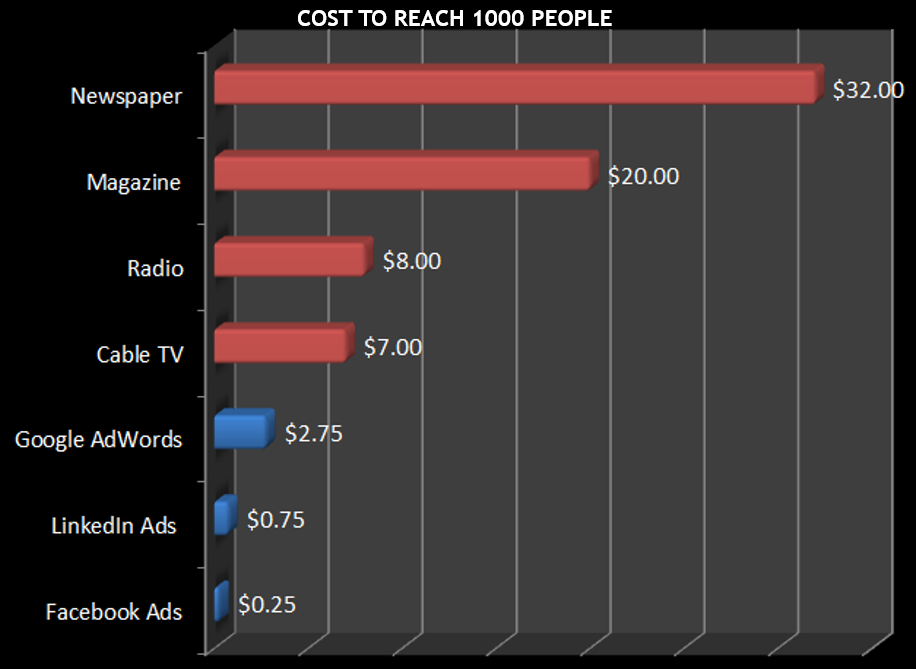
In terms of cost, to reach a thousand people, Facebook is far less expensive than all other platforms, including online and offline marketing.
You can spend $1 a day on Facebook ads, and reach 4,000 people that would’ve never seen you otherwise. That’s $30 a month. If you can’t afford that, then you may not be in business for long.
#3: The Targeting Capabilities of Facebook Are Outstanding
Because you scale so much detail, Facebook targeting capabilities is beyond belief. Not to mention the options of ad types, such as video ads. You can literally target President Barack Obama or his wife Michelle Obama. It can be age range, ethnicity, languages, geographical locations, demographics, behaviors, interests, or connections, you can get really detailed with the targeting capabilities and structure them with each other to increase your chances of getting rid of any users that aren’t your target audience.
#4: Facebook Is Effective to Push Potential Leads Down the Funnel
Still not convinced? Try re-marketing by custom audiences. This is a great strategy that does wonders. Remarketing words is targeting a specific audience that’s been to your website already, and would be more likely to show interest in your services or products.
#5: Facebook Allows You to Find New Qualified Leads Easily
When you’ve found your target audience, and getting them to convert effectively, you can duplicate them. This is called “lookalike audiences” where you can take that custom audience and have Facebook reach others that are similar to that audience, and likely to be interested in what your business offers.
Lookalike audiences are built with conversion pixels, data from installed mobile apps, or those that have liked your Facebook business page. You can also breakdown the size and targeting options to increase your chances of lookalike audiences accurately reflecting your target buyers.
This takes some guesswork out of targeting for user acquisition, which leads to a revenue increase.
Are you doing Facebook ads, or interested in doing them? If not, you should be! No matter if you’re looking to get more likes, shares, or convert users into leads, we can help you get started. Contact us for FREE advice on the best way to advertise your business on Facebook.
ATX Web Designs is an web design firm based in Round Rock & Austin, Texas. We don’t just build websites, we build websites that build business.
Reviews are very important. Did you know that 4 out of 5 consumers actually reverse their purchase decisions based on negative online reviews?
There has been much controversy with the nature of Yelps display algorithm and Review Filter, but don’t allow that to discourage your business from offering excellent services and products, and engaging with your target audience to gain great reviews from your customers and clients, and responding to their online reviews. Understanding what drives reviews from Yelp has become a major issue to online marketing strategies.
If the review isn’t a good one or if it’s a 5 star review regulated by Yelp’s automatic filter, most businesses have found it beneficial when engaging with customers that have left a review. Some business have even gone as far as to file class-action lawsuits against Yelp alleging that the automatic filter is configured to force businesses to pay for Yelp Advertisement. Unfortunately, none of the lawsuits have been successful.
Currently Yelp hasn’t disclosed what’s driving their review filter with much detail, but we’ve concluded a few basic assumptions based on our observations. Knowing what provokes Yelps review filter will give you better insight on what it takes to overcome Yelps domination.
➤ How’s your ranking on local and organic search results? Ranking for local SEO and organic SEO
There are certain behavior types that are likely to force a review into the not recommended status. Whether good or bad, not recommended reviews won’t be taken into account when determining the businesses overall review average.
Yelps FAQ section give the most information about the way they filter reviews. They describe their recommendation process as follows:
“We use automated software developed by our engineers to recommend reviews from the Yelp community. The software looks at dozens of different signals, including various measures of quality, reliability, and activity on Yelp. Most of all, however, it’s looking for people who are intrinsically motivated to share the wide range of rich and detailed experiences they have every day with local businesses. On average, our software recommends about three quarters of the reviews that are submitted to the site.”

One of the most common ways to trigger the filter is first-time Yelp users. Say, for example, someone loved the services that you’ve provided at your local business and wants to give you a review on Yelp. If it’s this person’s first review, he/she will more than likely not be too motivated to complete a profile just to leave a review.
This can trigger the automatic Yelp filter to categorize the review as not recommended. Sadly, this filter unfairly benefits first-time Yelp users that join with the intent of posting a bad review.
The absence of social media integration and social engagement is another common reason for filtered reviews. If they’re not using Facebook or Twitter as part of their Yelp interactions, it can raise a red flag. If a reviewer has added he/she social media profile to their Yelp profile, it stands a greater chance of having their reviews posted as recommended.
If a Yelp user has posted all five-star reviews, there’s a good chance that all of his or her reviews will be automatically filtered out. We aren’t making the suggestion that you should provide less than perfect service, but we’re sharing details to help you better understand what might cause a not recommended status on a great review submitted by one of your customers or clients.
This potential filter can cause a lots of frustration to those on vacation or have come back from traveling only to get back home and go to submit a review. If a review doesn’t come from an IP in close range to the business, then there’s a good chance of it be pushed into the non-recommended section.
Yelp uses cookies to track engagement. If a business gets multiple reviews back to back that have come from the same device, they’ll be marked as not recommended. In this situation, the filter is structured in a way so to reduce fraudulent reviews, both positive and negative. This filter is mainly intended to keep everyone honest.
This is pretty much a hit or miss, but we noticed Yelp reviewers who have numerous reviews marked as funny or useful hold a better chance of having his or her reviews stay as recommended. As a business owner if you’re engaging with Yelpers, you should time out to mark reviews as funny or helpful. By doing this, you are not only helping shoppers, but increasing the credibility and engagement power of other Yelpers as well. Don’t hold back on your clicks.
Yelp, in itself, is still a community. Yelp reviewers that have Yelp friends are more likely to have some form of credibility and their reviews will stick. Being socially friendless, won’t stand a chance, either a business or as an individual. Taking more time to engage with other Yelpers at a social level, both online and offline, will be beneficial.
Keep in mind that asking for Yelp reviews is against Yelp’s policies. We recommend you spend time engaging with past reviewers by responding to their reviews to give you the best chance to earn your reviews fair and square.
Yelp is a absolutely huge when it comes to building your online reputation, and it can definitely help you expand your online marketing reach, even without advertising. Don’t overlook the review platform and allow it to go to waste.
Do you need help getting more reviews from your customers or clients? We can help with that! Contact us for more information.
ATX Web Designs is your Online Business Marketing, web development and web design firm in Round Rock & Austin, Texas. We don’t just build websites, we build websites that build business.
Just imagine the situation: you have spent several excruciating days working on a big puzzle that consists of a thousand pieces. After your hard work you get so close to its end that you can see it clearly. But when you are fitting the last pieces in, you suddenly realize that you have a missing piece of the puzzle, so it can’t be completed.
In this case you feel frustration because you can’t complete the puzzle without the one missed piece. Exactly the same feelings business owners have when after weeks and months of frazzling work, and doing all things right they are not being found online. In this article you will find common local search marketing mistakes of business owners and ways that will help you to complete your puzzle.
DISCREPANT NAME, ADDRESS, & PHONE NUMBER
The name, addresses and phone number of your business must be exactly the same across your listing directories. Otherwise, it can lead to a lack of credibility for the business. Here is the explanation: In order to confirm that your business has the correct name, address, phone number etc., Google will scan a big amount of websites. Any mismatch can cause a lack of trust in your business.
Remember that in this case, “close” is not good. As a business owner you’re looking for all advantages that you can get, so details are very important.
For example, your business is located at 330 West 40th Street. But you may use variations of the address when you publish information about it to online directories: 330 West 40th St., 330 W. 40th Street, 330 West 40th Street, etc. Online directories in most cases recognize abbreviations. Despite this, it’s important to publish the same data to every directory in order to increase recognition of your business.
The Solution: study all online listings where your business is presented and check the information. It has to be accurate and discrepant. Don’t forget that you can hire an outsourcing company that will do it for you if you want to have the best result and save your time.
PERMITTING LISTINGS TO BECOME INVISIBLE
You have to remember that getting your pages verified, with consistent and discrepant information, is the main thing that can help your business to be found online. At the same time it’s a complex process. Adding information about the name of your business, its address and phone number to your pages will help in the short perspective, but a successful page is provided by a permanent presence.
The Solution: Always be present on your business pages! Sign in at least several times a month to update important information about your business such as store hours, add new (alternative) phones etc., run the blog, get customer feedback. Make posts or respond to comments or reviews if it is a page in Google+!
ABSENCE OR LACK OF PRESENCE IN SOCIAL MEDIA
Engagement of audience in Social Media is one of the ways of evaluation of consumer interest that search engines conduct. Some businesses don’t think that social media will benefit them, and while it’s true that different businesses would get more value from various social media sites, it’s important to be active on at least a few platforms. Nevertheless, it’s important to be proactive on some platforms because social media activity is one of indicators that Google uses while ranking businesses.
The Solution: Always be proactive on your pages in social media. Post relevant and interesting content on a regular basis which suits you: twice a day, twice a week or twice a month. Use entertaining content to attract new followers. You can also promote your blog or webpages with the help of instruments of social media sites such as Instagram, Facebook, and Twitter.
GET MORE CUSTOMER REVIEWS
Customer reviews are very important indicator of customer satisfaction and credibility for the business. Search engines take into account reviews of real customers about their experience with your company. It’s hard to be competitive on the market without positive reviews. The matter is not only in engines. Many customers trust online recommendation, which is why they are so important.
The Solution: It’s not hard for you to ask your customers to leave a review about their experience with your business. But sometimes this process can be long, and receiving a positive review requires a lot of time. That’s why business owners can hire outsourcing companies, such as RevLoval, that has a review generating platform which helps clients get customer reviews.
Mastering these four solutions, will get you the best advantages for your business. It is the lost puzzle that you now have found. If it’s hard for you to run online activities you can hire a professional company that will help you get your business being found online. Imaging how great it is when the puzzle is completed and your business is noticed online. So don’t hesitate and start working!
ATX Web Designs is your ‘Business Marketing ‘ company that specializes in online marketing and web design in Round Rock and Austin, Texas. We don’t just build websites, we build websites that build business.
Let’s build the solutions your business needs to grow.
Book a strategy callLet’s build the solutions your business needs to grow.
Book a strategy call